


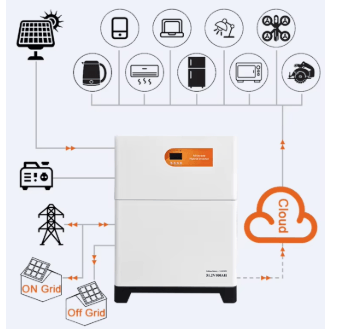
Understanding and Selecting Home Backup Battery Systems
Have you ever experienced this situation? Just as you are about to watch a movie or send an urgent document to a client, the house suddenly goes pitch black, leaving only the faint glow of your phone.
In the past, when we encountered such circumstances, we could only search in the dark for a candle. However, nowadays, an increasing number of households are beginning to take control of their “power autonomy” into their own hands.
You’ve probably heard many terms like household batteries, energy storage systems, and backup power supplies. Simply put, they’re essentially a ‘power bank’ installed in your home.
I. What exactly is a household backup battery?
In simple terms, a household backup battery system is a device that stores electricity. This energy can be sourced from rooftop solar panels or from the grid during off-peak hours, when electricity rates are lowest.
Its core structure typically consists of three components:
- Battery pack: A storage facility for electrical energy.
- Inverter: Converts direct current (DC) from batteries into 220V alternating current (AC) for household appliances.
- BMS (Battery Management System): Serving as its ‘brain,’ it monitors battery conditions to prevent overheating and overcharging.
In addition to the thin-film batteries hung on walls, a more intriguing concept has emerged in the industry—the battery container home. This is a container-style residential energy storage design. Don’t be intimidated by the word “container”; it doesn’t mean placing a freight container in your yard; rather, it refers to a highly integrated, modular energy storage solution.
It’s like Lego bricks—if your home is a large villa or a small studio with high electricity consumption, this system can safely encapsulate large amounts of energy like a container. This design not only installs extremely quickly but also offers excellent fire and disaster resistance, making it a very popular trend in the current high-end residential energy storage market.
II. Why Should You Install a Battery System at Home?
1. Rejecting the Electricity Bill “Backstabbing”
Modern electricity pricing schemes have grown increasingly complex, with many regions implementing “peak and off-peak pricing.” The cost of electricity peaks at 5 PM when households turn on air conditioners, while it drops to its lowest at 2 AM when most people are asleep.
With backup batteries, you can employ a smart energy management strategy: charge your batteries at midnight during off-peak hours, then disconnect from the grid in the evening when rates are higher, using stored electricity at lower cost. This cyclical approach can significantly reduce your monthly electricity bill.
2. The “Soul Mate” of Solar Panels
If you install solar panels but omit batteries, you’re essentially wasting energy. During peak sunlight hours at noon, you might not be home, and by the time you return at night to use electricity, the sun has already set.
With batteries, daytime sunlight becomes nighttime lighting. Particularly when paired with high-capacity solutions like battery container homes, you can even operate without grid power for days, completely eliminating electricity bills.
3. Protect your “delicate” household appliances
Modern precision electrical appliances are widely used, and unstable grid voltage can cause significant damage to computers, high-end audio systems, and smart refrigerators. The backup battery system functions as a buffer, delivering more stable current than the grid power supply, thereby extending the lifespan of these high-power electrical devices.
III. When making a purchase, these parameters must be closely monitored.
When browsing products in-store or online, sales representatives will present you with a barrage of data. Don’t panic—focus on understanding these four key points:
1. Power (kW) vs Capacity (kWh)
These two terms are visually similar but have entirely different meanings.
- Power (kW): Determines how many appliances you can use simultaneously. For example, if the power is too low, you cannot turn on the microwave while using the air conditioner.
- Capacity (kWh): Determines how long your power supply lasts. To illustrate: Power corresponds to the water flow rate of a faucet, while capacity refers to the water storage capacity of a tank. For households with multiple appliances, higher power capacity is essential. If you need to withstand prolonged power outages (e.g., selecting a more flexible battery container or home architecture), a larger capacity is required.
2. Charge-discharge depth (DoD)
Don’t assume a battery labeled 10 kWh will deliver 10 kWh of energy. Many older battery technologies degrade rapidly if used exclusively in dry conditions.
High-quality lithium batteries (like those used in PiForz) support discharge depths of 90% or higher. Always ask when purchasing: “What percentage capacity does this battery retain?” The higher the retention rate, the greater its value.
3. Round-trip efficiency
During the process of storing and releasing electricity, energy loss (heat) occurs. In a system with an efficiency of 90%, storing 10 kWh of electricity yields 9 kWh upon retrieval. Do not underestimate this 10% difference, as accumulated energy represents substantial financial losses.
4. Warranty Period
Household batteries are capital-intensive assets that require at least a 10-year service life. When evaluating warranty coverage, it is essential to consider not only the duration but also the “cycle count.” Generally, batteries supporting over 6,000 cycles are classified as first-tier products.
IV. Three practical considerations you must address before installation
1. Is it compatible with your solar panels?
Many homeowners install batteries later, so you need to verify whether the inverter in your battery system can integrate seamlessly with your existing photovoltaic system.
2. How long is the power outage switching duration?
In low-end systems, switching to battery power takes several seconds after a power outage, by which time your computer has already restarted, and files are lost. A high-quality system (with UPS functionality) can complete the switch within 10 milliseconds, leaving you completely unaware of even a flicker in the lights.
3. Where do you plan to put it?
Traditional household batteries are typically mounted on walls. However, if you opt for a battery container home system with a higher capacity, it usually requires a flat surface or a dedicated corner.
Thanks to its high safety rating, these systems remain secure even when installed in semi-outdoor spaces like garages or storage rooms, freeing up valuable indoor living space.
V. Summary: Was this money well spent?
If you ask me, I’d say: This isn’t just about buying equipment—it’s about purchasing’ certainty. ‘With evolving energy structures and climate instability, rising electricity costs and grid fluctuations may become the new normal.
A reliable home backup battery system allows you to comfortably enjoy air conditioning and cold cola while neighbors scramble during power outages. The enhanced quality of life and sense of security derived from such convenience cannot be measured by simple monetary terms.