

From Capital to Governance: Raigul Dzhetpisova’s Integrated Framework for Energy Megaprojects
by Nick Fuga
You could say that, for the global energy industry, capital has historically been seen as the main hurdle to major infrastructure projects. The thinking was plain enough for decades: put in place the funding, the technical know-how, and the political blessing, and a project would get done.
Yet the track record of the world’s biggest energy megaprojects tells a different story. It is not so simple as having the money anymore. These are not mere financial exercises; at the scale of tens of billions of dollars, they become governance systems in their own right.
You need to bring investors, governments, lenders, auditors, regulators, and operating partners into alignment for what can be a matter of decades.
So the real test these days is not just a project’s ability to attract capital, but the strength of its governance to see that capital through all the risks, institutional wrangling, and market swings.
This is the area where Raigul Dzhetpisova’s work stands out.
Raigul is no stranger to the international energy sector, having spent more than 30 years with companies such as Chevron and Tengizchevroil. In her role as a senior financial executive there, she was the General Manager of Finance at the latter.
Her career has put her in the middle of some of the more intricate governance and financial problems facing the global oil and gas industry.
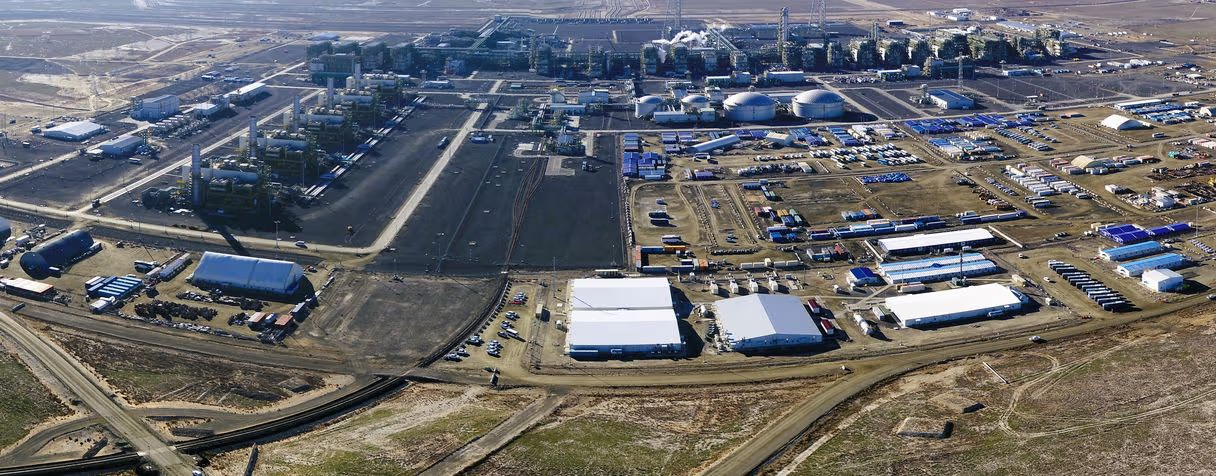
Take, for instance, the Future Growth and Wellhead Pressure Management Projects at Tengizchevroil in Kazakhstan. As one of the biggest energy expansion undertakings in the world, they are no ordinary assignments. With capital investment running to about $45 billion, you cannot rely on conventional budgeting or controls.
You need an entire system that can integrate capital planning, partner sign-offs, tax compliance, and risk oversight with the long-term discipline that sovereign regulators expect. At that scale, there is no separation between the two: a lapse in governance is a financial risk, and every decision has governance implications.
Within this environment, Mrs. Dzhetpisova helped oversee financial governance structures supporting approximately $45 billion in capital investment associated with the Future Growth Project and Wellhead Pressure Management Project, as well as financing strategies involving approximately $20 billion in external funding requirements.
The governance architecture incorporated staged capital approvals, partner alignment mechanisms, regulatory oversight, financial controls, and risk-management processes designed to maintain transparency, accountability, and long-term project discipline throughout the investment lifecycle.
What sets Mrs. Dzhetpisova apart is her redefinition of finance’s role in these kinds of megaprojects. She does not see it as a back-office exercise in cost control and reporting; instead, she has made it a matter of strategic governance. Under her model, finance is the architecture that ties together institutional trust, transparency, regulation, and capital.
Through her leadership of multinational energy ventures, Mrs. Dzhetpisova developed what has become known as Raigul Dzhetpisova’s Integrated Financial Reporting and Governance Framework for Multi-Corporation Energy Joint Ventures (IFRGF).
Developed over decades of experience overseeing large-scale energy investments and joint-venture structures, the framework addresses the challenge of aligning financial reporting, governance, regulatory compliance, capital planning, and stakeholder accountability among multiple corporate partners, sovereign stakeholders, regulators, lenders, and external auditors.
By integrating these traditionally fragmented functions into a unified operating architecture, the framework enhances transparency, institutional trust, decision-making efficiency, and long-term project sustainability.
This is all the more pertinent in the current climate. The energy sector is a far more uncertain and fragmented place now. On one hand, you have investors who must account for everything from ESG and climate exposure to political instability and supply chain hiccups.
On the other hand, governments want to shield their national interests even as they court long-term capital. It is up to companies to please both and still deliver their technically demanding projects on time and at the required scale.
Through her research and professional practice, Mrs. Dzhetpisova has set about resolving this kind of tension through an integrated approach to the governance of energy megaprojects: namely, by forging stronger connections among public-private coordination, reporting transparency, regulatory stability, and project financing.
Take the matter of megaproject financing, for instance. For large infrastructure in emerging markets, it is not simply a case of putting together debt or equity. What you need is an institutional setup in which risk-sharing, joint ventures, sovereign capital, and special-purpose vehicles all function as a single entity.
You have to look at more than just the availability of funds to understand why a $40 or $50 billion venture succeeds, says Mrs. Dzhetpisova. It is really about how capital structure, sovereign input, and governance design come together.
This perspective reflects a departure from traditional project-finance approaches that focus primarily on capital availability and financing instruments. Mrs. Dzhetpisova’s work emphasizes that institutional governance, clearly defined decision rights, regulatory predictability, reporting transparency, and stakeholder alignment are equally critical determinants of whether large-scale investments ultimately succeed.
These principles became foundational elements of her Integrated Financial Reporting and Governance Framework for Multi-Corporation Energy Joint Ventures.
It is a departure from the way megaproject finance is normally viewed. The old model would have you focus on the instrument itself, whether a bond, loan, or guarantee. Her approach is to put things in their proper perspective: without credible institutions, a sensible regulatory environment, and unambiguous decision rights, your financing plan is for naught.
Take the dynamic between governments and investors. Most energy megaprojects are inextricably linked to the state, be it through licensing, political stability, or environmental and customs rules. Then there is Mrs. Dzhetpisova, who has been looking into foreign investor councils and similar bodies to better understand the relationship.
Her aim is to determine whether a formal dialogue can be held to support any legislative changes and put an end to regulatory uncertainty. This is not your typical lobbying; in countries where these projects are of strategic national importance, she sees it as an institutional mechanism.
Done right, it gives the government insight into an investor’s constraints and lets the investor know where regulatory priorities lie, creating a more stable environment.
Then there is the matter of tax reform in the oil and gas sector, which her work puts a new spin on. The state is generally viewed as using taxes to put revenue in its coffers, but Mrs. Dzhetpisova has a different take: she considers it an instrument for governing investment.
When you are dealing with a capital-intensive project, the one thing that can make or break an investor’s decision to commit funds, or to let a competitor have them, is the stability of the tax regime.
You see a broader truth in Mrs. Dzhetpisova’s comparison of the British sector of the North Sea with Kazakhstan: tax reform is never an isolated affair. What it achieves depends on institutional credibility, policy predictability, and governments’ ability to reconcile their fiscal agenda with the demands of long-term investment.
In the North Sea you can count on tax design to make or break the case for new investment; in an emerging market, fiscal discipline is what shows investors you are an institution of some maturity.
Then there is the matter of financial reporting governance, the fourth pillar of her integrated framework. Energy multinationals have to function in all sorts of jurisdictions and under different regimes.
They might have to make International Financial Reporting Standards and national accounting rules sit comfortably with Sarbanes-Oxley internal control requirements. When you have a project with several corporate and sovereign parties at the table, that kind of reporting is more than just checking a compliance box. It is what builds trust.
Mrs. Dzhetpisova puts forward a framework to do just that, one that unifies IFRS, SOX-type controls, and local obligations, reducing fragmentation and putting investors at ease. When information voids in your global operations inflate the cost of capital, transparency becomes something of a strategic asset.
Elements of this governance approach were implemented across multinational operating environments that required alignment among International Financial Reporting Standards (IFRS), Sarbanes-Oxley internal control requirements, local statutory obligations, and complex joint-venture governance structures.
By reducing reporting fragmentation and strengthening transparency, the framework sought to improve institutional confidence among investors, regulators, lenders, operating partners, and sovereign stakeholders while supporting more effective decision-making across large-scale international energy ventures.
Collectively, these four dimensions add up to something of a contribution to the field and form Raigul Dzhetpisova’s Integrated Financial Reporting and Governance Framework for Multi-Corporation Energy Joint Ventures, a model developed through decades of leadership experience in multinational energy operations.
By integrating capital structuring, fiscal stability, regulatory engagement, reporting transparency, and institutional governance into a single operational framework, the model offers a practical methodology for managing the complexity of modern energy infrastructure investments and multi-corporation energy partnerships.
The thesis is that you cannot look at finance in a vacuum; projects only come off when the financial side is part of a governance structure robust enough to handle complexity. Capital structuring, tax stability, and the working relationship between government and investor are all part of the same equation.
There is a certain heft to this research given her professional pedigree. These are not notions hatched from academic theory but born of hands-on experience with the scale and oversight of multinational energy operations.
The framework itself emerged from practical experience overseeing governance, financial reporting, capital planning, regulatory compliance, and stakeholder coordination within one of the world’s largest energy joint ventures.
Rather than being developed as a theoretical construct, it evolved through direct application in environments involving multinational shareholders, sovereign interests, external auditors, lenders, regulators, and large-scale capital investment programs.
She was up against that kind of thing at Tengizchevroil’s Future Growth Project, where one had to juggle the demands of capital markets and partner alignment with the sovereign’s expectations.
That has implications for the industry as a whole. The kinds of problems she tackles are found in a wide range of settings, from LNG terminals and cross-border pipelines to petrochemical complexes and sovereign industrial ventures. Before capital can be turned into infrastructure, it has to pass through those institutional and regulatory gauntlets.
With the world’s energy sector now facing transition and security headwinds alongside a fight for investment, the skill to govern capital could well prove as vital as raising it. From now on, a project’s governance architecture will be as much a measure of its worth as its technical or resource potential.
There is a certain reality to be faced, and Raigul’s Integrated Financial Reporting and Governance Framework for Multi-Corporation Energy Joint Ventures offers one response to that challenge. In a sense, it is a reflection of how financial leadership has evolved in the energy sector. It allows you to see megaprojects for what they are: intricate institutional systems, not simply another financial transaction.
The modern finance executive is no longer content to just watch over the books and hold costs down; with megaprojects, the job is much more strategic, essential to the project’s viability and to putting investors at ease while fortifying the institution. You will find that Mrs. Dzhetpisova makes this case with clarity in her work, bringing a seasoned perspective to the design and maintenance of these large-scale energy endeavors.
Her work suggests that the long-term success of major energy infrastructure projects depends not only on access to capital but also on the ability to establish integrated systems of governance that align financial reporting, regulatory compliance, stakeholder accountability, risk oversight, and institutional decision-making across multiple corporate and sovereign participants.
As energy investments become larger, more international, and more complex, such integrated governance frameworks may become increasingly important to ensuring project resilience, transparency, and sustainable value creation.
Her thesis is plain to see: when you are dealing with multi-billion-dollar infrastructure, capital will get the project off the ground, but governance will decide whether it lasts.
Article by Nick Fuga
