


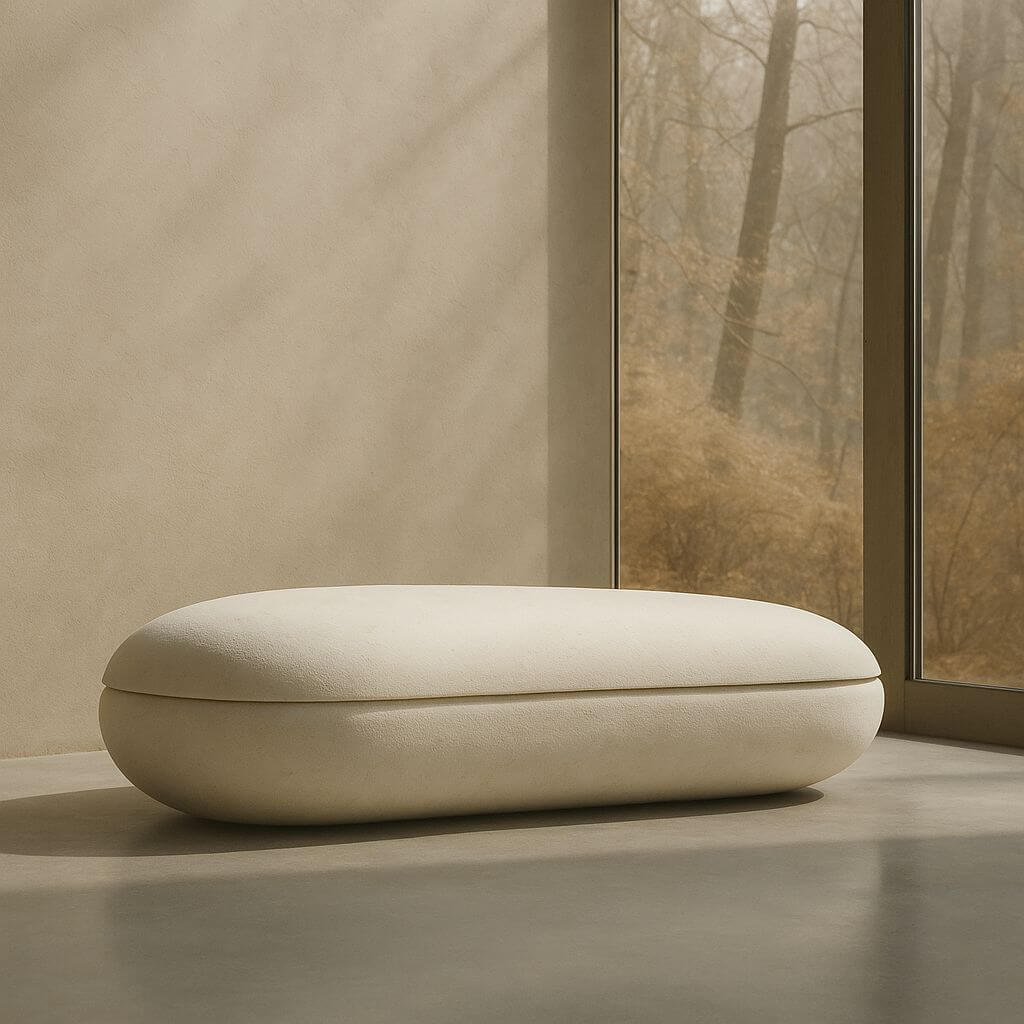
Designing for Decomposition: Jordanna Ibghy Is Rethinking the Architecture of Death
For most of the built environment, sustainability is the goal. Buildings are engineered to last, materials chosen to resist decay, structures designed to outlive their makers. Jordanna Ibghy, a designer trained in architecture, spent years working within that logic before turning it on its head — asking what it would mean to design for decomposition rather than against it.
That question has become the foundation of her practice. As founder and lead designer of Urth Ritual, Ibghy has developed a line of mycelium-based coffins and urns for a funeral industry that has changed little over the past century. Mycelium, the root structure of fungi, is not a conventional design material.
It has to be cultivated rather than sourced, and it behaves nothing like the wood, metal, or stone that funerary design has relied on for generations. Translating it into objects precise enough for ritual use, strong enough to serve their function, and simple enough to return fully to the earth after burial required Ibghy to build a design vocabulary largely from scratch.
“Every material decision in architecture is really a decision about time — how long something is meant to last, and what happens after,” Ibghy has said of the work. “I wanted to design something honest about the fact that it’s all meant to be transformed.”
That framing is where Ibghy’s training as an architect shows most clearly. Long before founding Urth Ritual, she studied the built environment not just as structure but as a system of cycles — how materials move from raw form to function, and back again — and how design can make that cycle visible rather than hide it.
Her graduate research examined embodied movement through landscapes shaped by ritual and memory, from the Camino de Santiago to the Kumano Kodo, work that now informs the way she designs for death care: not as a clinical endpoint, but as a passage with its own material and spatial language.
That thinking carries through in the designs themselves. Ibghy’s work is unadorned and precise — organic in material but architectural in form, drawing on the same discipline of proportion and material honesty that defines her broader design practice.
Rather than design for a niche environmentalist market, she built her practice around what she describes as “everyday people who appreciate natural beauty” — a deliberate choice that reflects a designer’s instinct for audience as much as an entrepreneur’s.
In doing so, Ibghy has effectively originated a design category that barely existed before she began envisioning it: funerary design built around biology instead of preservation, treating decomposition not as a problem to be solved but as the final, natural stage of a life well lived.
It’s a quiet but significant contribution to the broader conversation, covered elsewhere in these pages, about what sustainable design looks like when applied to industries that sustainability advocates rarely consider.
As cities and industries alike look for models of genuinely circular design, Jordanna Ibghy’s work stands out as an example of what happens when an architect’s eye for material cycles is turned toward one of design’s oldest, most avoided problems: how we let things end.