

From Sensors to Savings: How Structured Network Cabling Enables Smarter Energy Management
Smart energy management depends on more than efficient HVAC equipment, LED lighting, and intelligent sensors. Those devices also need a dependable way to exchange information.
For building owners, facility managers, and sustainability teams, structured network cabling provides that underlying connection. When sensors, controllers, meters, and building management systems can communicate reliably, energy data becomes more useful and automated controls can respond more precisely to changing conditions.
Energy savings start with accurate building data
Modern buildings can collect information from occupancy sensors, temperature monitors, smart meters, lighting controls, air-quality sensors, and equipment controllers. The value comes from connecting those readings to systems that can act on them.
Consider an office with occupancy sensors in individual zones. When a meeting room is empty, the building management system might reduce lighting and adjust temperature settings rather than conditioning the room as though it were occupied. Similar controls can respond to daylight levels, equipment schedules, and changes in demand.
The U.S. Department of Energy describes building controls as the systems that coordinate components such as HVAC, lighting, and other equipment while managing comfort, energy use, and operating costs. Its research also focuses on using sensing, monitoring, and controls to improve whole-building energy performance (U.S. Department of Energy).
The important point is that a sensor’s reading must reach the appropriate controller or software consistently. Poor connectivity can create missing data, delayed commands, or monitoring gaps that reduce the usefulness of otherwise capable equipment.
Structured cabling gives smart devices a common foundation
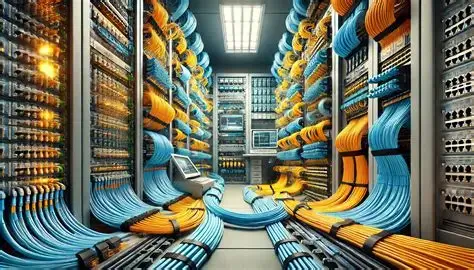
As buildings add connected equipment, installing a separate communication path for every individual system can become difficult to manage. Structured cabling provides an organized network architecture that can support devices across multiple floors, zones, and building functions.
Depending on the application, that infrastructure can connect occupancy sensors, access controls, wireless access points, lighting controllers, cameras, and other Internet Protocol (IP) devices. Using the appropriate data cable for the network design also matters because cable category, distance, environment, and power requirements can affect how reliably connected equipment performs.
A structured approach makes future changes easier as well. If a facility adds sensors to previously unmonitored rooms, replaces controllers, or introduces new energy-management software, technicians can work from documented pathways and connection points instead of tracing an assortment of unrelated cables.
That matters for sustainability because energy management isn’t a one-time installation. Buildings change. Tenants move, room functions shift, equipment is replaced, and monitoring strategies become more detailed. Infrastructure that can accommodate those changes reduces the need to rebuild the communications layer every time the energy strategy evolves.
Reliable connectivity makes automation more useful
Energy management systems need dependable information before they can make useful decisions. A temperature sensor with intermittent connectivity, for example, may leave a control system working from incomplete information. An occupancy sensor that can’t communicate consistently may prevent lighting or ventilation schedules from responding as intended.
Wired connections can be especially useful for fixed devices that continuously report data or support important building functions. Wireless technology still has an important role, particularly where running new cable is impractical. The better approach isn’t automatically wired or wireless everywhere. It is choosing connectivity according to the device, environment, maintenance requirements, and expected data traffic.
Structured infrastructure also makes it easier to connect different parts of the building into a broader management system. That can give facility teams a clearer picture of where and when energy is being consumed instead of treating lighting, HVAC, and other systems as isolated operations.
Green City Times has previously discussed how IoT sensors can support smart energy management by monitoring energy consumption across buildings and public infrastructure. A well-planned communications network is what allows that sensor data to move from individual devices into useful monitoring and control applications.
Plan the network alongside the energy strategy
Cabling is easiest to overlook when a project team focuses primarily on visible technologies such as smart thermostats, meters, and automated lighting. Yet network requirements should be considered early, particularly during new construction or a major renovation.
Start by identifying what needs to communicate. Map the locations of sensors, controllers, equipment rooms, wireless access points, and management systems. Then consider cable pathways, expected connection density, environmental conditions, future expansion, and whether certain devices will receive both data and electrical power through the network.
It also helps to leave room for change. Installing only enough infrastructure for today’s device count may save materials initially, but additions can become more disruptive later. Accessible pathways, documented ports, sensible equipment locations, and spare capacity can make subsequent energy-efficiency projects easier to implement.
The goal isn’t to connect every possible device. It is to create an infrastructure where the devices that matter can communicate dependably and where new monitoring points can be added without redesigning the building’s entire network.
Better energy management needs a dependable information path
Sensors may detect wasted energy, and building management software may decide how to respond, but those components still need a reliable way to exchange information.
Structured network cabling provides that often-overlooked layer. By planning connectivity alongside sensors, controls, and energy systems, building teams can create a more adaptable foundation for monitoring consumption, automating responses, and making better-informed efficiency decisions over the life of the property.