

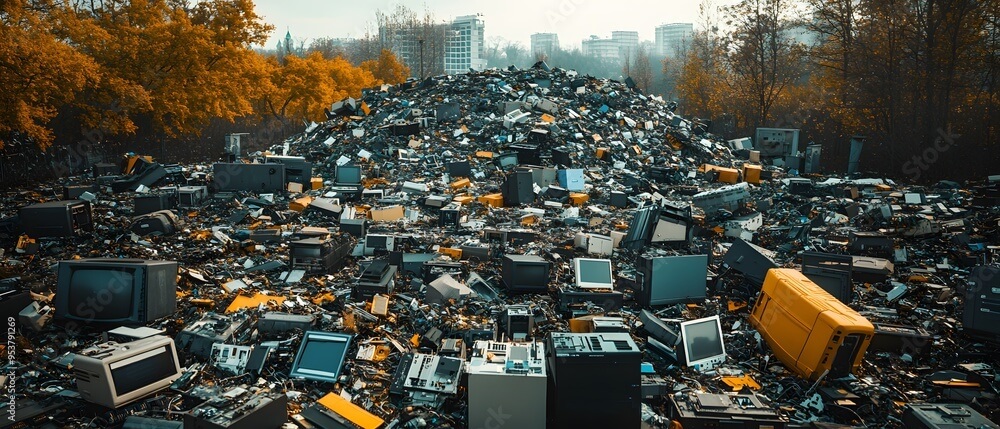
Secure Data Destruction Doesn’t Have to Mean More Landfill Waste
The assumption that secure data destruction results in more landfill waste persists across industries managing sensitive drives.
SSDs and HDDs containing confidential information often require physical destruction at end-of-life to meet compliance requirements. Companies can protect data while reducing their e-waste footprint through destruction methods designed with material recovery in mind.
The Global Electronic Waste Crisis
Digital dependency continues to accelerate across industries, bringing severe environmental consequences.
In 2022, an estimated 62 million tonnes of e-waste were produced globally, with only 22.3% documented as formally collected and recycled. The remaining material often ends up in landfills or informal processing streams, representing millions of tonnes of potentially recoverable materials lost to improper disposal each year.
E-waste pollution causes long-lasting effects on soil health and agricultural productivity, with heavy metal contamination reducing crop yields and threatening food safety. Establishing sustainable end-of-life practices for electronic devices becomes increasingly urgent.
The challenge lies in balancing strict data security requirements with environmental stewardship.
Destroying Sensitive Drives While Reducing E-Waste
Physical destruction is often the most appropriate option for end-of-life SSDs and HDDs containing highly sensitive data, especially when organizations need documented destruction and strong risk mitigation.
However, secure destruction need not come at the expense of the environment. When the process is handled responsibly, the materials from destroyed devices can still be recycled.
For example, Phiston Technologies demonstrates this approach by manufacturing high-security equipment that physically destroys storage drives while supporting responsible e-waste recycling.
Its specialized destruction equipment is designed with NSA guidelines in mind, and breaks drives down into small particles, making the original data difficult to reconstruct and the devices unusable.
Phiston provided secure physical destruction for Gothenburg’s Data Centers and maintained environmental responsibility through eco-friendly disposal practices.
The destruction process can also support environmental goals. Once the drives are destroyed, recyclable materials can be separated and recovered rather than sent directly to a landfill.
Recovering materials, such as metals and plastics, enables their reuse in other products, reducing the need for new materials and lowering the environmental impact of electronic waste.
Secure Asset Tracking Prevents Landfill Waste
Comprehensive tracking systems for end-of-life assets prevent devices from entering waste streams prematurely. National Express worked with IT asset disposition partners to protect both data and the environment.
A qualified technical engineer visited the data center to unplug, de-rack and transport assets in a secure, tracked vehicle, with every item receiving documentation establishing its chain of custody from removal onward.
Assets underwent data erasure via Blancco three times at the processing facility before being separated into reusable items and e-waste, with recycling conducted in accordance with WEEE legislation.
National Express received detailed reports documenting both the erasure process and disposal methods, demonstrating how strict chain-of-custody standards can coexist with proper material routing to recycling channels rather than landfills.
Extending Device Life Cycles Through Refurbishment Programs
When security requirements allow it, old storage devices do not always need to be destroyed or discarded. Some hard drives and SSDs can be securely cleared, repaired and reused through refurbishment.
For example, between June 2021 and June 2022, Seagate’s refurbishment program restored 1.16 million hard drives and solid-state drives for safe reuse. This refurbishment supports sustainability by saving the raw materials and energy that would otherwise be needed to produce replacement drives.
This approach also reinforces a circular economy, where products are kept in use for as long as possible instead of being thrown away. Refurbished storage devices can also make technology more affordable.
Schools, small businesses and other organizations can use reliable refurbished drives without needing to purchase the newest equipment. By keeping functional devices in use longer, refurbishment can reduce electronic waste while getting more value from technology that has already been produced.
However, refurbishment is not the right choice for every device. Organizations must consider how sensitive the information stored on a drive is before deciding what to do with it. Devices containing highly sensitive corporate or government data may need to be physically destroyed to prevent unauthorized access.
Securing Data While Protecting the Planet
Companies managing sensitive electronic assets can achieve both strict data security and environmental responsibility through thoughtful disposal strategies. Methods that emphasize material recovery reduce the global e-waste footprint while meeting compliance requirements.
Implementing proper asset tracking, partnering with certified processors and evaluating devices for refurbishment potential all contribute to sustainable practices.
Investing in solutions designed with recyclability in mind protects both confidential information and the environment. The technology exists to achieve both goals simultaneously, requiring only the commitment to integrate sustainability alongside security in procurement and disposal decisions.