

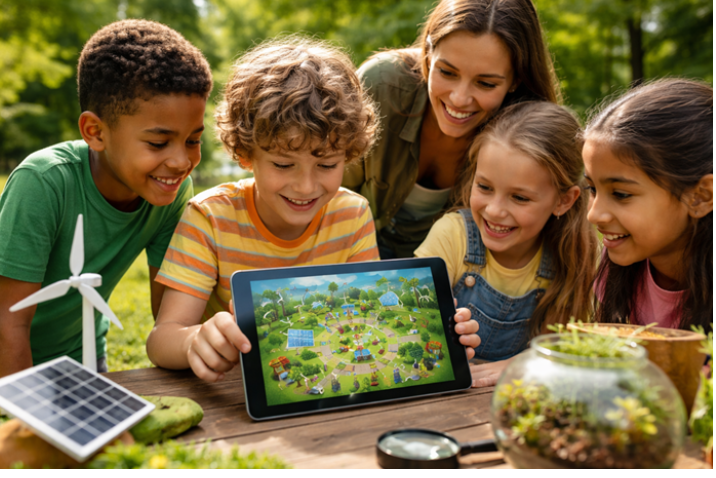
How We Can Teach People About Environmental Issues Through Educational Games
Today, environmental issues are no longer merely topics confined to the pages of books. In 2025, the WMO confirmed that 2024 was the hottest year on record – approximately 1.55°C above the pre-industrial average. NASA, too, identified 2024 as the warmest year on record. The UNEP’s 2024 Emissions Gap Report further indicates that delays in reducing emissions are pushing us toward dangerously high temperatures.
In such times, limiting environmental education to mere speeches or lecture notes is simply not enough. When you provide people with a learning experience through games, these issues feel more tangible, and the solutions become more memorable.
Why Environmental Issues Should Be Turned Into Games
Environmental issues often appear vast, complex, and somewhat daunting. Topics such as climate change, plastic waste, water scarcity, deforestation, and pollution can sound overwhelming. While many acknowledge the gravity of these issues, they often struggle to connect with them in the context of their daily lives.
This is precisely where educational games serve as a powerful bridge. Within a game, you do not merely hear about a problem; you experience it firsthand, visualize its effects, and grasp its consequences. It is this immersive experience that deepens the learning process.
When a child or young person witnesses the repercussions of deforestation, water wastage, or improper waste management within a game, it leaves a lasting impression that goes beyond mere factual recall. It evokes an emotional response and a sense of connection within them. And it is this very emotional engagement that ultimately drives behavioral change.
Which Types Of Games Are Most Effective?
Not all games have the same impact. For environmental education, the most effective games are those that require players to engage in problem-solving. For instance, while building a city, a player might have to decide how to conserve energy, where to route waste, or how to keep a river clean. In such games, players witness the immediate consequences of their decisions.
Role-playing games can also be highly effective. In these games, a student might assume the role of a farmer, a city planner, a school environmental representative, or a water conservation activist. This allows them to gain an understanding of different perspectives. They come to realize that a single environmental issue can impact the lives of various individuals in distinct ways.
Simulation-based games are another valuable tool. These games allow you to create realistic models of a forest, a river, a city, or a village. When a player observes that rising pollution levels are depleting fish populations or that water wastage is adversely affecting agricultural fields, the learning experience becomes both direct and deeply impactful.
What Environmental Concepts Can Be Taught Through Games?
When integrating environmental education into games, the content should be concise, clear, and directly relevant to real-life situations. You can teach players how to segregate waste, conserve water, understand the importance of saving electricity, recognize the positive impact of planting trees, and grasp why single-use plastics are harmful.
Simply awarding points for every correct action within a game is not sufficient. The true impact is achieved only when the player also understands the underlying rationale behind that action. For instance, if a player places waste in a recycling bin, the game can show them that this reduces landfill volume and conserves resources. Similarly, if they decide to conserve water, they can be shown just how critical this need is in drought-prone regions.
How
The greatest strength of educational games lies in their ability to transform learning into an active process. In traditional academic settings, individuals typically absorb information by listening or reading. In a game, however, they make decisions, commit errors, observe the outcomes, and then attempt the task again. This iterative process deeply embeds the concepts within the mind.
This approach proves particularly effective in environmental education, where memorizing facts alone is insufficient. The ultimate goal is to help people understand that even their seemingly minor daily habits can have a significant impact on the natural world.
When games demonstrate the tangible impact of conserving water, the benefits of waste segregation, or the transformative power of choosing eco-friendly alternatives, players begin to draw connections between these actions and their own lives.
In many ways, harmful habits such as overconsumption, wastefulness, and neglect of nature can be compared to the modern environmental seven deadly sins, in which small negative actions collectively lead to large-scale damage.
A 2025 study demonstrated that digital game-based learning improved students’ environmental knowledge and attitudes. Another study found that immersive gameplay helped foster a deeper emotional connection to environmental issues. This clearly illustrates that games are not merely a form of entertainment; they can also serve as powerful tools for shifting mindsets.
How
You do not need a large budget; even small games can have a powerful impact. Teachers can facilitate card games, board games, quizzes, or digital interactive activities within the classroom. Community centers can host team-based games where children and adults work together to devise solutions.
If you are a teacher, be sure to discuss after the game concludes. This is, in fact, the most critical component. It is when you ask children after the game has ended what they learned, which decisions they found challenging, and what changes they can implement in their real lives, that learning truly translates into behavioral change. Without this discussion, the game risks remaining nothing more than a fun activity.
You can also create small games at the household level – for example, a week-long “Environmental Challenge” where a small habit is changed each day. One child might focus on saving water, another on avoiding plastic bags, and another on segregating household waste. When framed as a game, these tasks are no longer perceived as a burden.
Key Considerations For Creating A Good Game
Rather than making a game overly complex, it is better to keep it clean and engaging. The rules should be simple, the language straightforward, and the objective of each level easily understood. Players should feel a sense of progression as they advance. Furthermore, both victory and defeat within the game should be underpinned by clear causes, ensuring that the learning experience remains complete and meaningful.
A good environmental game does not instill fear; instead, it offers hope. It teaches that even small steps can make a difference. A sense of hope serves as a powerful motivator for people to take action. When players realize that their decisions can help save forests, conserve water, or purify the air, they begin to adopt these same behaviors in their real lives.
Conclusion
Environmental education becomes far more effective when it connects directly with people. Educational games are uniquely suited to accomplish this task naturally and intuitively. They simplify complex issues, evoke emotional engagement, and provide a practical platform for practicing sound decision-making.
If your goal is to offer people not merely information, but a genuine experience, then games present an excellent avenue. Through this medium, you can simultaneously foster environmental awareness and cultivate responsible behavior.