

How IoT and E-Ink Technology are Driving Zero-Waste Smart Retail in Sustainable Cities
For decades, physical stores have relied on paper price tags, a practice that generates catastrophic amounts of waste. A standard mid-sized supermarket houses tens of thousands of individual products, requiring constant pricing updates due to promotions or inflation.
This operational necessity forces stores to print, discard, and reprint millions of small paper tags annually. The environmental toll extends far beyond deforestation, encompassing the energy-intensive logistics of paper distribution.
Furthermore, commercial printing utilizes chemical-heavy inks and adhesives that complicate the recycling process. When these toxic materials inevitably reach local landfills, they contribute to soil and water contamination, directly violating zero-waste urban planning initiatives.
E-Ink Technology: A Leap in Energy Efficiency
In the push for greener urban infrastructure, the retail sector is actively eliminating paper waste through digitalization. Traditional paper price tags require constant reprinting, contributing heavily to deforestation and toxic ink waste.
To combat this, modern smart stores are adopting IoT-driven pricing systems equipped with multi-stable E-Ink screens. For instance, industry hardware manufacturers like Shunyco develop advanced zhsunyco that retain display information without continuous power consumption.
These digital alternatives drastically reduce both the carbon footprint and operational waste in retail environments. By integrating these scalable systems, municipalities can systematically lower the baseline resource consumption of their commercial sectors.
How Multi-Stable Displays Conserve Power
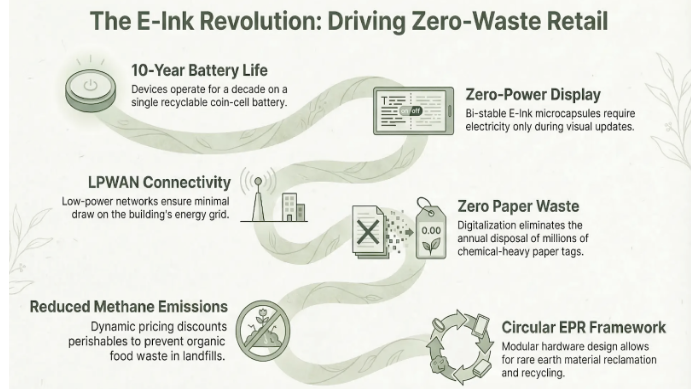
The fundamental advantage of electronic ink (E-Ink) lies in its bi-stable or multi-stable technological architecture. Unlike traditional LCD or LED screens that require a constant electrical current to emit light, E-Ink microcapsules only consume power during a visual update.
Once the digital price or product data is pushed via the store’s IoT gateway, the display physically holds the pigment in place. The tag requires absolutely zero electricity to keep the image visible, even in the event of a total facility power loss.
This unique hardware capability results in several ecological benefits:
- Decade-Long Battery Life: Devices can operate for up to 10 years on a single, recyclable coin-cell battery.
- Minimal Grid Draw: The overarching IoT network utilizes low-power wide-area network (LPWAN) protocols, barely registering on a building’s energy meter.
- Micro-Energy Harvesting: Future hardware iterations are increasingly compatible with ambient light harvesting, pushing devices toward absolute energy autonomy.
Reducing Carbon Footprint Through Supply Chain Digitization
Replacing physical paper is only the first step; the true environmental value of digitized retail lies in operational interconnectivity. When shelf-edge displays communicate directly with central inventory databases, the entire supply chain becomes optimized.
This synchronization allows retailers to track product lifecycles with pinpoint accuracy. By leveraging strict energy efficiency protocols within their data centers, stores minimize the physical and digital overhead required to manage vast amounts of stock.
Inventory Accuracy and Food Waste Reduction
One of the most pressing environmental crises in urban environments is organic food waste. When perishable goods expire on supermarket shelves, the carbon emissions associated with their production, transportation, and eventual decomposition are entirely squandered.
IoT-connected tags enable Dynamic Pricing, a strategy where algorithms automatically discount perishable items as they approach expiration. This real-time markdown process incentivizes immediate purchase, dramatically reducing the volume of unsold food sent to landfills.
The macro-environmental benefits of dynamic pricing include:
- Lowering Methane Emissions: Diverting organic waste from landfills directly reduces the atmospheric release of methane, a potent greenhouse gas.
- Optimizing Freight Logistics: Accurate, real-time stock data prevents over-ordering, reducing the number of heavy delivery trucks idling on city streets.
- Streamlining Labor: Staff are freed from manual price auditing, allowing them to focus on waste-sorting and sustainable store operations.
Implementing Circular Economy Principles in Retail Tech
Transitioning to smart retail isn’t solely about operational efficiency; it is a critical step toward achieving global climate goals. By minimizing paper use and optimizing inventory life-cycles, the retail industry directly supports sustainable consumption.
According to the United Nations Environment Programme, integrating robust circular economy practices in resource-heavy sectors is essential for halving global greenhouse gas emissions and preserving natural resources for future generations.
True sustainability requires looking beyond the immediate use-phase of retail hardware. Hardware developers, store operators, and city planners must collaborate to ensure these digital solutions do not eventually become hazardous electronic waste.
Managing E-Waste and Extending Device Lifespans
The mass deployment of IoT devices introduces the challenge of eventual disposal. To maintain ecological integrity, responsible manufacturers are adopting stringent Extended Producer Responsibility (EPR) frameworks.
This involves designing digital tags with modular components, allowing for the easy extraction and safe recycling of batteries and display panes. When a device reaches the end of its retail life, the rare earth materials are reclaimed rather than incinerated.
Furthermore, extending the hardware lifespan through over-the-air (OTA) firmware updates ensures that devices remain highly functional as network protocols evolve. This delays hardware obsolescence and keeps toxic components out of municipal waste streams.
Key Takeaways
| Area | Key Takeaway | Impact/Data |
| Hardware | Adopt bi-stable E-Ink displays | Achieves 10-year battery life |
| Pricing | Implement IoT dynamic pricing | Slashes perishable food waste |
| Logistics | Synchronize supply chain data | Prevents freight over-ordering |
| Lifecycle | Enforce modular EPR recycling | Reclaims rare earth materials |
Conclusion: The Future of Sustainable Urban Retail
The integration of IoT and E-Ink technology is not merely a retail upgrade; it is a foundational pillar for sustainable urban development. By actively eliminating physical waste and optimizing resource distribution, digital shelves directly support the ecological mandates of modern green cities.
As hardware efficiency continues to improve and circular recycling programs mature, zero-waste commerce will transition from an ambitious goal to a standardized reality. The future of the urban economy depends on this seamless integration of intelligent, low-impact technology.