

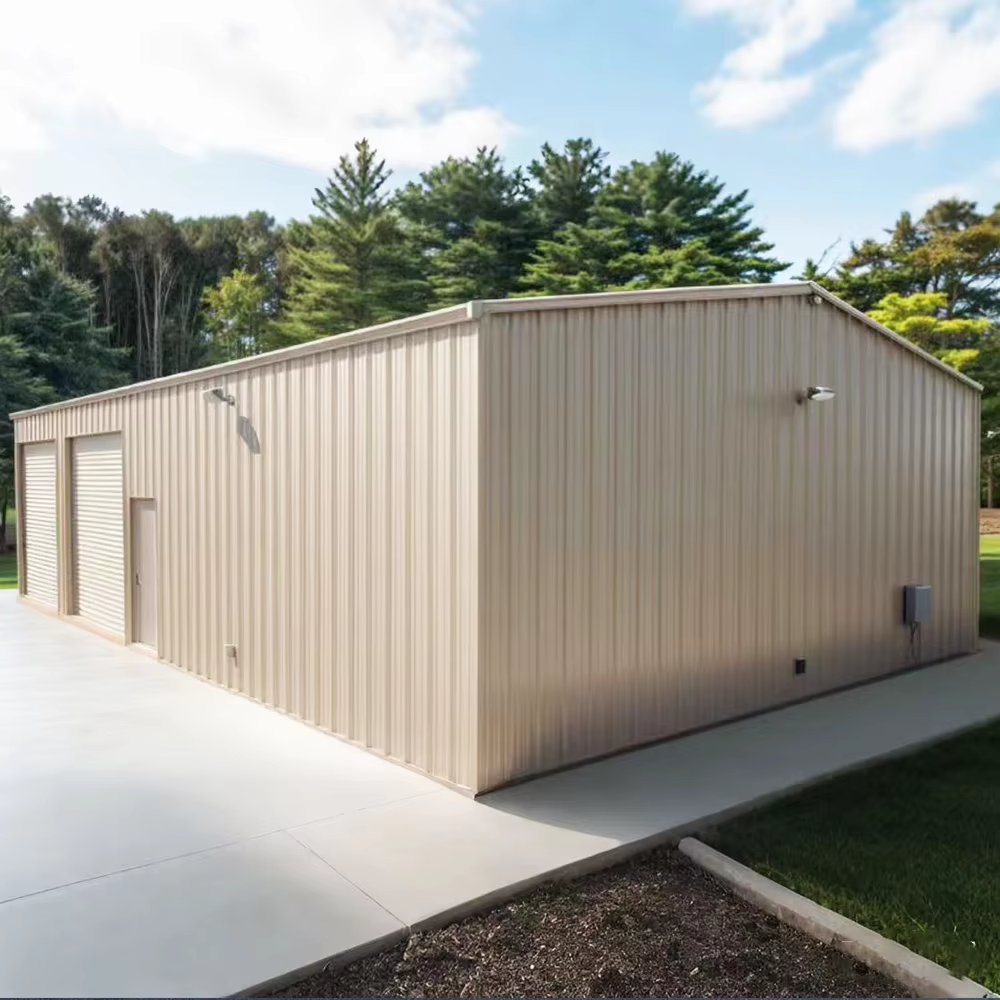
7 Reasons Demountables Are Gaining Popularity in Sustainable Building
The construction industry is under increasing pressure to reduce its environmental footprint, and the solutions gaining the most traction aren’t always the ones that make the loudest noise.
Demountable buildings, structures designed to be assembled, disassembled, relocated, and repurposed rather than demolished, have been quietly accumulating a compelling case as one of the more practical responses to the sustainability challenge in built environments. They’re not new, but the context around them has changed significantly.
Rising material costs, tightening environmental regulations, growing demand for flexible infrastructure, and a broader shift in how developers and organisations think about long-term asset value have all converged to make demountables more relevant than ever.
Here’s a detailed look at why they’re gaining serious traction in sustainable building circles.
1. They Reduce Construction Waste
Traditional construction generates an enormous amount of waste, offcuts, packaging, materials ordered in excess, and debris from site preparation and finishing work. The construction and demolition sector is consistently one of the largest contributors to landfill in most developed countries, and the end-of-life demolition of conventional buildings adds another significant waste burden on top of the building phase itself.
Demountable structures address this at both ends of the lifecycle. The manufacturing process is factory-controlled, which means materials are cut and assembled with precision that minimises offcuts and excess.
At the end of life, rather than being demolished and sent to a landfill, the components are disassembled and either reused directly or recycled. According to the American Institute of Architects, designing buildings for deconstruction and reuse is one of the most effective ways to reduce the significant material waste the construction sector generates annually, a principle that demountable buildings put into practice by design rather than as an afterthought.
2. The Carbon Footprint Is Significantly Lower
The embodied carbon of a building, the emissions associated with manufacturing, transporting, and assembling its materials, is an increasingly important metric in sustainable construction. Demountable buildings tend to perform well on this measure for several interconnected reasons:
- Factory fabrication uses materials more precisely, reducing waste and energy consumption compared to on-site construction
- Shorter build periods mean less machinery operation and fewer vehicle movements to and from the site
- When a structure is relocated rather than demolished and rebuilt, its embodied carbon is effectively spread across multiple use cycles
That last point is particularly significant. A conventional building absorbs its full carbon cost once, then gets demolished. A demountable structure spreads that same investment across several deployments, making each successive use progressively more carbon-efficient than starting from scratch.
3. Flexibility Reduces the Need for New Construction
One of the simplest sustainability benefits of demountable buildings is also one of the most overlooked: a structure that can be moved doesn’t need to be replaced. Instead of demolishing and rebuilding every time needs change, the same building relocates and gets back to work.
The range of situations this applies to is broader than most people realise:
- Schools needing extra classrooms during construction or growth periods
- Construction sites requiring offices, lunchrooms, and amenities
- Businesses scaling up quickly without committing to permanent infrastructure
- Event and community organisations needing temporary facilities
As Aussie Demountables’ experts explain, relocatable building solutions remove the need for new permanent construction each time requirements shift, whether that’s a school expanding its facilities, a business scaling up quickly, or a construction site needing temporary amenities.
The more applications a single structure serves over its lifetime, the smaller its overall environmental footprint becomes. It’s a sustainability outcome that’s both straightforward and genuinely significant.
4. They Can Be Reused, Repurposed, and Recycled
The circular economy is essentially about keeping materials in use for as long as possible rather than throwing them away. Demountable buildings fit this model naturally, perhaps better than any other building type.
When a demountable structure is no longer needed in one location, it doesn’t get demolished and sent to a landfill. It gets taken apart carefully, and the components are reused either in the same configuration or in a new one. Materials that genuinely reach the end of their useful life can be recycled far more cleanly than those locked into a conventionally built structure.
For organisations with formal sustainability commitments, whether reporting against the Global Reporting Initiative or working toward green building certification, this is a meaningful, practical advantage. Demountables don’t just support circular economy principles on paper; they demonstrate them in a way that’s visible and measurable.
5. Factory Fabrication Improves Quality and Reduces Site Impact
Construction sites are disruptive to surrounding communities, to local ecosystems, and to the broader environment through noise, dust, vehicle movements, and the management of site waste and run-off. The more of the construction process that can be moved off-site into a controlled factory environment, the smaller that footprint becomes.
Demountable buildings are predominantly fabricated off-site, with on-site work largely limited to foundation preparation and assembly. This means:
- Significantly reduced vehicle movements to and from the site
- Shorter on-site construction periods that minimise community disruption
- Better quality control through factory conditions versus weather-exposed site work
- Reduced risk of site-related environmental incidents like sediment run-off or chemical spills
The quality benefits of factory fabrication also translate into longer service life, structures that are built more precisely tend to perform better and last longer, which is itself a sustainability outcome.
6. They’re Increasingly Meeting Green Building Standards
A persistent misconception about demountable buildings is that they represent a compromise on quality or environmental performance relative to permanent construction. That gap has narrowed considerably as the sector has matured.
Modern demountable structures can be designed and specified to meet, and in some cases exceed, the thermal performance, energy efficiency, and indoor environment quality standards required for green building certifications.
Insulation, glazing, mechanical systems, and building envelope design in contemporary demountables are subject to the same engineering rigour as permanent buildings. For projects pursuing formal sustainability certification, this means demountables are increasingly a viable rather than a fallback option, one that can meet the required standards while delivering the additional flexibility and lifecycle benefits that permanent construction cannot.
7. They Reduce Long-Term Resource Consumption
The sustainability conversation around buildings tends to focus heavily on the construction phase, but operational resource consumption over a building’s life is equally significant. Demountables that are properly specified for their climate and use case can perform as well as permanent buildings in terms of energy and water consumption.
Their ability to be reconfigured or upgraded without demolition means that improvements in building performance can be implemented more cost-effectively over time.
When an organisations needs change, as they inevitably do, a demountable facility can be adapted, expanded, or reduced in footprint without the waste associated with demolishing a permanent structure and rebuilding. That adaptability is a meaningful long-term resource efficiency advantage that permanent construction simply cannot offer.
Final Thoughts
Demountable buildings have moved well beyond their reputation as purely temporary or utilitarian structures. The combination of reduced waste, lower embodied carbon, circular material flows, and genuine operational flexibility makes them one of the more coherent responses to the sustainability demands being placed on the built environment.
As those demands continue to intensify, driven by regulation, corporate commitment, and the straightforward reality of resource constraints, the case for demountables as a mainstream sustainable building solution will only continue to strengthen.