

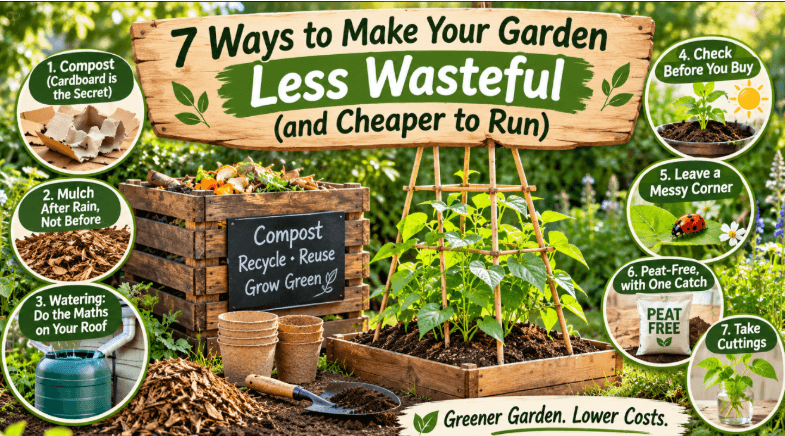
7 Ways to Make Your Garden Less Wasteful (and Cheaper to Run)
I’ll be straight with you: a sustainable garden isn’t about owning a wormery or a wildflower meadow. It’s about not throwing away money, water and effort. Here are seven fixes. The first four cost next to nothing, and the last three need a little more thought.
1. Compost (cardboard is the secret)
Everyone says “greens and browns”. What they don’t say is that most people run short of browns, because a kitchen produces wet waste every day and dry waste only occasionally.
Keep a stack of torn-up egg boxes and toilet roll tubes next to the caddy and add a handful with each load. If the heap still turns to slime, you’ve simply got too much going in at once, so stop adding and fork it over.
Expect six months at the quick end, and a year or more if you don’t turn it.
2. Mulch after rain, not before
Timing matters more than the material here. Mulch laid over dry ground traps that dryness underneath, and the bed can stay parched for weeks even though it looks tidy on top.
I’d wait for a properly wet day, or soak the bed with the hose first, then spread your compost, leaf mould, or bark chips to a depth of about 5 to 7cm, stopping short of any woody stems, which can rot if buried. Weeds drop off noticeably in the first season, and you’ll find yourself watering about half as often.
3. Watering: do the maths on your roof
Rainwater is the easiest saving in the garden, and you can work out what’s on offer. Take a 6 square metre shed roof. A 10mm shower puts roughly 60 litres down its gutter. A typical water butt holds around 200, so after two or three showers you’re full, and that’s before you count the house roof.
Then there’s how you use it. One or two proper soaks a week do far more good than a little every day, ideally first thing in the morning and delivered onto the soil around the base of the plant rather than over the leaves. Drop the daily evening sprinkle. It keeps roots shallow, because they never need to go looking for water.
4. Check before you buy
It’s worth knowing three things about the spot before a plant goes anywhere near your trolley: how much sun it really gets, whether the soil is light and sandy or heavy clay, and whether it floods in winter or bakes in summer.
Get any of those wrong, and the plant will cost you far more than the price on the label, in watering, feed and eventual replacement. The lowest-risk buys are natives and plants suited to your area, and local insects tend to use them more.
For more practical gardening advice, learn how to match plants to your garden’s conditions before spending money on them.
5. Leave a messy corner
Hoverfly and ladybird larvae get through a lot of aphids, but they won’t stay in a garden that’s been tidied to within an inch of its life. Any corner will do for a wilder patch, as long as you leave it alone.
Hollow stems are best kept standing until spring, since plenty of insects overwinter inside them. If you can get something in flower during as many months as possible, there’s always food around, and a shallow dish of water with a few stones in it gives insects somewhere safe to drink.
On pest sprays, I think you’re better off without them. Broad-spectrum insecticides kill the helpful insects along with the pests, and the aphids bounce back first. A squashed aphid or a blast from the hose is usually enough.
6. Peat-free, with one catch
Peat bogs took thousands of years to form, and they hold a lot of carbon, which is why digging them up for potting compost is so hard to defend now that decent alternatives are on the shelves.
There is a catch, though. Peat-free mixes are lighter and can dry out faster than you’d expect, so for the first few weeks, check pots more often than you think you need to. Lift the pot. If it feels light, water it.
Reuse pots and trays, and buy bare-root or plug plants when you can, since they involve far less plastic.
7. Take cuttings
Mint, rosemary and fuchsia are the easy starters. Cut a soft shoot, strip the lower leaves, and stand it in water or a gritty mix. You’ll usually have roots within a few weeks. Perennials can be split with a spade every few years, and the spare chunks make good swaps with neighbours.
Saving seed from open-pollinated veg and flowers works too, but hybrid seed may not come true.
Where to start
Don’t try all seven this year. Start with compost and watering, because they save the most, then add one more each season. They feed each other anyway: compost builds the soil, mulch protects it, and a deep soak lets it go further.