

How Does Banding Reduce Packaging Waste?
Packaging is one of the largest and most visible sources of waste in modern life, and much of it is thrown away within minutes of a product arriving. For manufacturers, retailers, and the cities that handle their trash, the key question is how to use less in the first place.
One overlooked answer is banding. So how does banding reduce packaging waste?
Banding reduces packaging waste by securing products with a narrow paper or plastic band instead of boxes, shrink film, or stretch wrap, so far less material is made, shipped, and thrown away.
That short answer leaves out what makes banding matter: the savings grow across the whole life of a package, from the material used and the fuel burned to ship it to what ends up in a recycling bin or a landfill. Looking at each stage shows why more operations are moving to it.
Why Packaging Waste Is a Problem Worth Solving
According to the U.S. Environmental Protection Agency, containers and packaging made up 82.2 million tons of municipal solid waste in 2018, or about 28 percent of everything Americans threw away that year. Corrugated boxes alone accounted for 33.3 million tons, the largest single product category the agency tracks.
Recycling helps, but it doesn’t solve the whole problem. The EPA reports that just over half of that packaging was recycled, while roughly 30 million tons went to landfills.
Plastic film, the material behind most shrink and stretch wrap, is especially hard to manage because most curbside programs don’t accept it, so much of it ends up in landfills even when it could, in theory, be recycled.
For cities trying to meet waste-reduction goals, this points to a simple priority. The most effective packaging is the packaging that never gets made. Reduction comes before recycling in the waste hierarchy for good reason, and banding has the most impact there.
How Banding Works Compared to Wrapping and Boxing
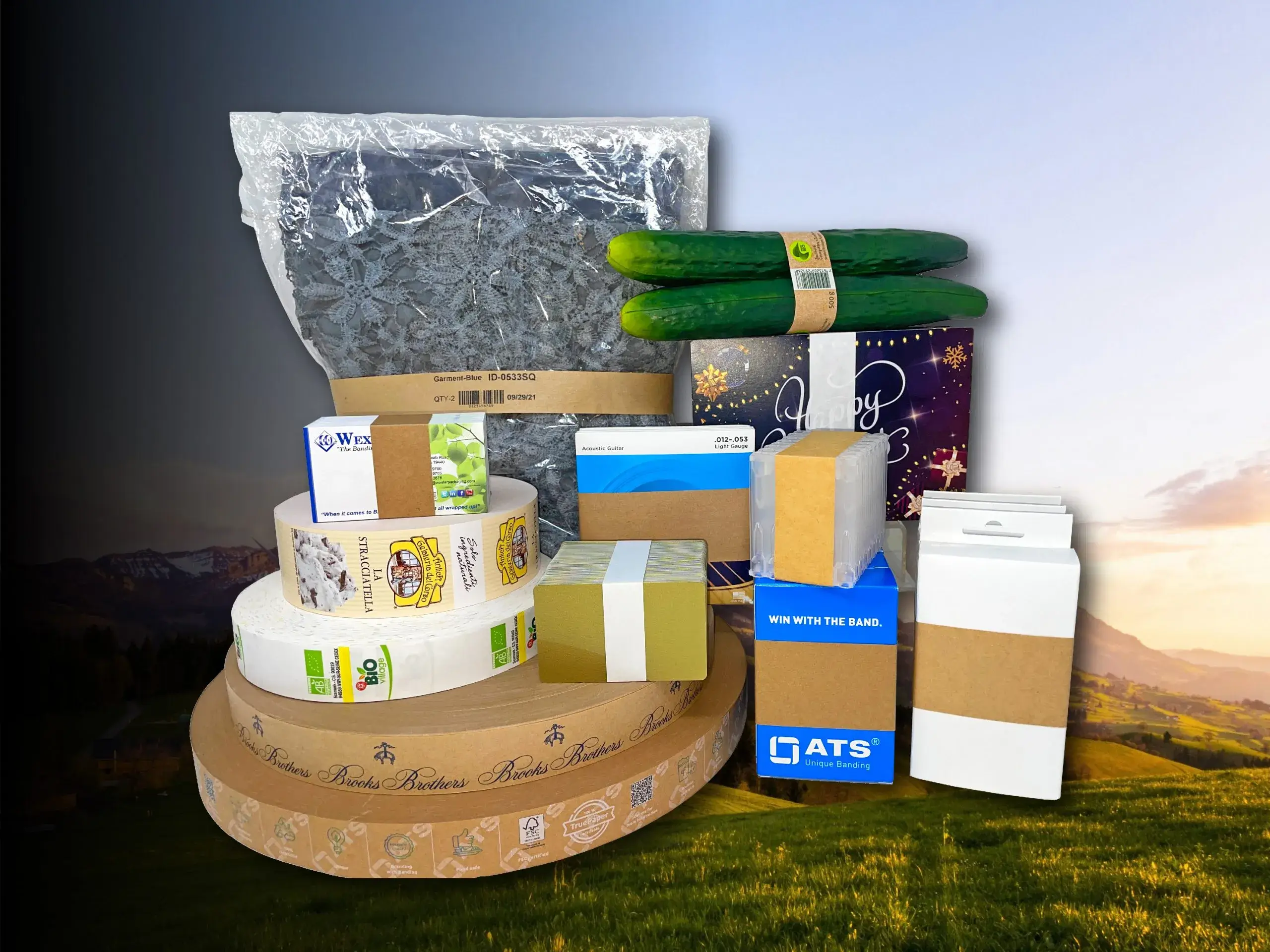
Banding wraps a single strip of material around a group of items and seals it, holding everything together firmly without covering it. Products like stacks of printed materials, bundles of produce, packs of consumer goods, or sets of boards can be grouped and moved using only a narrow band rather than a full layer of film or a corrugated box.
Shrink wrapping, by comparison, covers the entire product in plastic film and then heats it to tighten the fit. Stretch wrapping winds film around a load several times.
Both work, but both use far more material than a single band needs, and nearly all of it is discarded after one use. Operations weighing a move away from shrink film can learn more about banding and how it compares before running a small pilot.
Modern banding machines seal paper or film bands with ultrasonic or heat-seal technology, and some ultrasonic systems use less energy than traditional shrink film equipment. Felins, a Wisconsin packaging equipment maker that has worked in bundling since 1921, reports that switching to banding can reduce packaging mass by up to 95 percent compared to traditional methods, depending on the application.
What Materials Make Banding More Sustainable
The band material matters as much as how much of it is used. Paper bands can be made from FSC-certified paper and go into ordinary paper recycling streams, and some are compostable. For many products, that means the only packaging left behind is a strip of paper that fits into recycling systems most communities already run.
Where moisture resistance or product visibility matters, plastic film bands are an option. These can be made with post-consumer recycled content, and because each band uses so little material, the total plastic is still a small fraction of what full shrink wrap would use.
Choosing between paper and film usually depends on the product, how it will be stored, and what customers will do with the packaging. For businesses with sustainability targets, documenting that choice also makes it easier to report packaging reductions accurately.
How Banding Lowers the Carbon Cost of Shipping
Lighter, smaller packages take less energy to move. When products are banded instead of boxed or heavily wrapped, more units fit on a pallet and in a truck, and each shipment carries less dead weight in packaging.
Those savings add up across a supply chain. Fewer pallets and truckloads mean less diesel burned between factories, warehouses, and stores, which also cuts local emissions and congestion in the cities those trucks drive through.
There is also a savings at the end of the line. Retailers and distribution centers that receive banded goods have less packaging to break down, bale, and haul away, which reduces the volume entering municipal and commercial waste streams.
Which Industries Are Already Using Banding to Cut Waste
Banding is used far more widely than most people realize. Banks band currency, printers and mailers bundle publications and direct mail, and food and floral companies group produce and stems without covering them in plastic. Healthcare and pharmaceutical operations use banding to keep kits and cartons together, and manufacturers band everything from textiles to wood components.
E-commerce is a growing user base, too. As online orders produce more packaging per item delivered, banding lets fulfillment centers group multi-item orders or inserts without adding another box or bag.
These industries share a need to keep items together securely without fully enclosing them. Wherever that is true, banding is a practical way to remove packaging that served no real purpose.
Where to Start Cutting Packaging Waste
For any business serious about lowering its environmental footprint, the best first step is a packaging audit that identifies every product currently shrink-wrapped, stretch-wrapped, or boxed only to hold items together.
Those are the best candidates for banding, and replacing even a few can noticeably reduce the waste a company sends into its customers’ communities.