


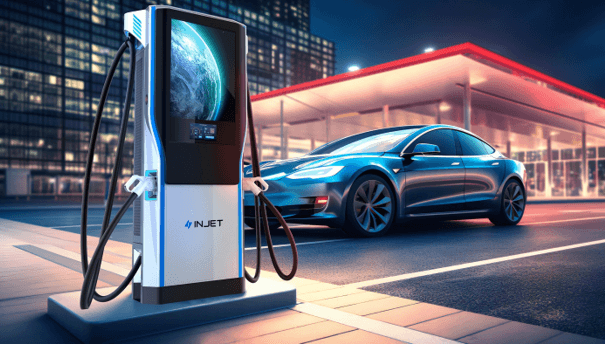
The Missing Link in Urban Decarbonization: Why EV Infrastructure is the Backbone of the Future Grid
The global push toward a net-zero future is no longer a peripheral environmental goal; it is the central economic and logistical challenge of the 21st century.
As the United States accelerates its transition to electrified transportation, spearheaded by federal initiatives such as the National Electric Vehicle Infrastructure (NEVI) Formula Program, the conversation is shifting. It is no longer just about the vehicles on the road, but the invisible infrastructure that sustains them.
For urban planners, fleet operators, and commercial real estate developers, the challenge is clear: how do we integrate millions of electric vehicles (EVs) into a grid that was never designed for them? The answer lies in the convergence of smart charging technology and renewable energy integration—a field where the hardware must be as intelligent as the software driving it.
The Paradox of Progress: EV Adoption vs. Grid Resilience
The narrative of EV adoption is often told through the lens of battery ranges and zero-emission tailpipes. However, the true complexity of the green revolution is found at the intersection of the vehicle and the grid.
In major American metropolitan areas, the influx of high-power charging demand threatens to overwhelm aging electrical transformers and distribution networks. This “grid strain” is the primary bottleneck for large-scale decarbonization.
To solve this, we must move beyond the concept of a charging station as a “passive plug.” Instead, the next generation of infrastructure must function as an active node in a decentralized energy network. This involves deploying smart charging protocols, such as OCPP (Open Charge Point Protocol), that enable real-time communication among the vehicle, the charger, and the utility provider.
This intelligence enables “Peak Shaving” and “Load Balancing”—strategies that ensure vehicles are charged when renewable energy is most abundant, and grid demand is at its lowest.
Beyond the Plug: The Role of Industrial-Grade Engineering
As cities seek to build resilient charging hubs, the reliability of the hardware becomes a matter of public and commercial safety. In the harsh environments of North American cities—ranging from the extreme heat of the Southwest to the freezing humidity of the Northeast—consumer-grade chargers are proving insufficient. Industrial-grade resilience is the new baseline for professional-grade EVSE (Electric Vehicle Supply Equipment).
Reliability in this sector is not merely about physical durability; it is about the efficiency of energy conversion. Every percentage point lost in the AC-to-DC conversion process represents a waste of renewable energy and an increase in operational costs.
This is where the engineering standards of global manufacturers play a pivotal role. Leading innovators like Injet New Energy have redefined these standards by developing integrated power modules that prioritize modularity and thermal efficiency.
By focusing on industrial-grade components that offer superior ingress protection (IP65 and above) and seamless protocol integration, these manufacturers are providing the technical foundation for sustainable cities.
Smart Cities and the Virtual Power Plant (VPP) Concept
The true potential of EV infrastructure is realized when it is integrated into a Virtual Power Plant (VPP). In a VPP model, thousands of EVs connected to smart chargers act as a massive, distributed battery. During periods of excess solar or wind production, these vehicles “soak up” the surplus energy. During peak demand, they can theoretically feed energy back into the system using Vehicle-to-Grid (V2G) technology.
While V2G is still in its early commercial adoption stages in the U.S., the hardware deployed today must be “V2G-ready.” This requires a level of forward-thinking in manufacturing that balances current cost-effectiveness with future-proof capabilities.
For commercial enterprises, investing in such infrastructure is no longer just a “green” checkbox; it is a strategic asset that provides long-term Return on Investment (ROI) through energy arbitrage and participation in demand-response programs.
The Economic Case for Sustainability
One of the most significant shifts in the American market is the realization that sustainability is good business. The Total Cost of Ownership (TCO) for a commercial charging hub is determined not by the initial purchase price, but by the uptime and maintenance requirements over a ten-year lifespan.
Cities like New York, Los Angeles, and Chicago are increasingly looking for “turnkey” solutions that minimize the need for on-site repairs. Hardware that features modular designs—where a single power module can be swapped out in minutes without decommissioning the entire station—is becoming the preferred choice for municipal and corporate fleets.
This modularity reduces downtime, ensuring that the transition to green energy does not compromise the operational efficiency of essential services.
Conclusion: A Collaborative Path to 2050
The road to 2050 is paved with high-efficiency cables and smart silicon. The transition to a green economy is a collaborative effort that requires aligning government policy, urban planning, and manufacturing excellence. As the United States continues to build out its national charging network, the focus must remain on the quality and intelligence of the infrastructure.
By prioritizing open-source protocols, high-efficiency conversion, and industrial-grade durability, we can ensure that the EV revolution is not just a trend but a permanent pillar of a sustainable, resilient urban future. The chargers of tomorrow will do more than just power our cars; they will stabilize our grids, utilize our sunlight, and build the foundation for the green cities of the next century.