


That 60-Year Metal Roof Has a Weak Spot You Can’t Ignore
By a metal roofing industry contributor
A standing seam metal roof is one of the most durable building materials you can choose. A technical study from the Metal Construction Association confirmed that the underlying steel panels can have a service life exceeding 60 years. But that impressive number hides a critical detail: the factory finish that protects the metal is not invincible. After 15 or 20 years, that original finish can begin to chalk, fade, or wear thin, especially under intense sun.
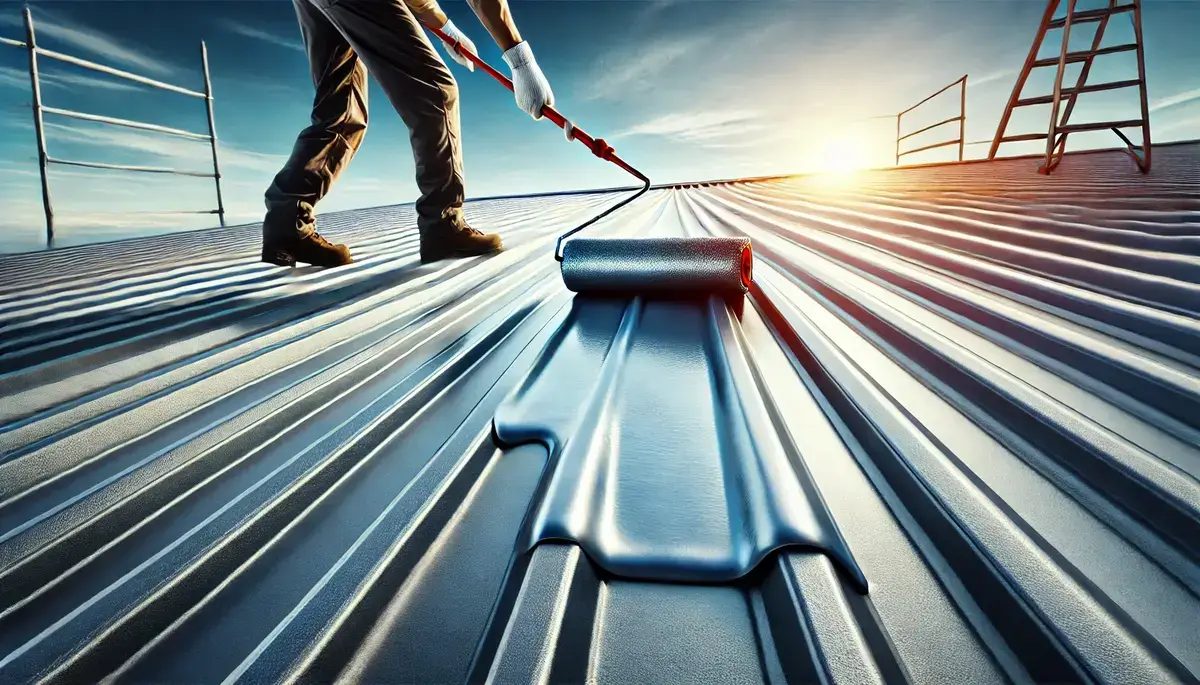
The performance gap often leads to issues. When a roof’s finish is compromised, the metal becomes susceptible to corrosion, and minor leaks can emerge at seams and fasteners. There’s no need to replace a roof that still has decades of structural integrity. This is precisely when building owners and property managers begin searching for a metal roof coating near me to restore the roof’s protective barrier and performance, avoiding the massive expense of a full tear-off. It’s a smart maintenance choice that safeguards the original investment.
❝ A common mistake is to view a roof coating as a thick layer of paint. It’s fundamentally different. A high-solids elastomeric coating is a monolithic, or seamless, membrane that is fluid-applied. It moves with the roof as it expands and contracts, which is something standard paint cannot do without cracking.
Quick answer: A metal roof coating is a strategic renewal of your roof’s protective layer, not just a cosmetic fix. Applied correctly, these systems stop existing leaks, prevent new ones from forming, and can significantly improve a building’s energy efficiency by reflecting solar heat.
What’s inside
- Can a Coating Really Lower Your Building’s Energy Bills?
- What Separates a Great Coating Job from a Failure?
- What Are the Main Types of Fluid-Applied Roofing Systems?
- Frequently Asked Questions
- The Bottom Line: Is a Coating the Right Move?
Can a Coating Really Lower Your Building’s Energy Bills?
Yes, by transforming your roof into a reflective surface that significantly reduces the building’s cooling load. This concept, known as a “cool roof,” is one of the most compelling financial arguments for applying a modern coating system. An aged, dark metal roof absorbs a tremendous amount of solar energy, heating up and transferring that heat directly into the space below. This forces your HVAC system to run longer and harder to maintain a comfortable indoor temperature, especially during peak summer months.
The savings are not theoretical. A reflective coating works by repelling solar radiation instead of absorbing it. According to the U.S. Department of Energy, a properly installed cool roof on a commercial building can generate annual cost savings of up to $0.64 per square foot, depending on the climate zone. This is a direct reduction in operational expenses. Reinforcing this, the U.S. Environmental Protection Agency notes that the average annual energy savings from a white roof is about 10 to 15 percent of the building’s total energy use. For a large facility, this represents a substantial and recurring return on investment.
❝ Ask a contractor about the coating’s Solar Reflectance Index (SRI). This value, from 0 to 100, measures a roof’s ability to reject solar heat. A higher SRI means a cooler roof surface. A standard dark roof might have an SRI of 20, while a high-performance white coating can exceed 100.
The mechanism is straightforward. By lowering the roof’s surface temperature, the coating reduces the amount of heat conducted into the building. This directly lessens the demand on air conditioning systems. The equipment cycles on less frequently and runs for shorter periods. This not only cuts electricity consumption but can also extend the service life of expensive HVAC units by reducing their overall wear and tear. The impact is most pronounced on buildings with large, low-slope roofs that have significant sun exposure throughout the day.
What Separates a Great Coating Job from a Failure?
The final quality of a metal roof coating depends almost entirely on meticulous surface preparation and verified application thickness. A premium coating material can fail in just a few years if applied to a poorly prepared surface. The contractor’s process, not just the product in the bucket, is what determines the long-term success of the project.
First, focus on surface preparation. The goal is to create a perfectly clean, dry, and stable substrate for the coating to bond to. This always begins with high-pressure washing to remove dirt, chalking, and loose material.
But it doesn’t stop there. Any areas of rust must be mechanically removed and treated with a rust-inhibiting primer. Every single screw, fastener, and seam needs to be inspected, tightened if necessary, and sealed with a high-solids sealant or detail tape. This is a non-negotiable step. For professional guidance, industrial projects often follow standards for surface preparation set by organizations like the Association for Materials Protection and Performance (AMPP), which ensures a baseline level of quality.
❝ Ask your contractor: “What specific surface preparation standard will you be following for this project, and how will you document the final dry film thickness?” Their answer will reveal a lot about their technical approach. A detailed, confident answer is a good sign; a vague one is a red flag.
Second, verify the application itself. Professional coatings are specified to be applied to a certain thickness, measured in “mils” (one-thousandth of an inch). This is called the dry film thickness (DFT). If the coating is applied too thinly, it will not provide the intended waterproofing or lifespan. A proficient contractor uses a wet film gauge during application to ensure they are applying the correct amount of material, which will then cure to the specified DFT. They should be able to explain their quality control process for achieving the manufacturer’s required thickness across the entire roof.
Finally, understand the warranties. There are typically two different warranties: one from the product manufacturer and one from the installing contractor. The manufacturer’s warranty covers defects in the coating material itself. The contractor’s warranty covers workmanship, meaning leaks or failures caused by improper installation. Be sure you receive and understand both documents. A long-term material warranty is only valuable if the workmanship is good enough to make it last.
| Evaluation Point | What to Look For | Red Flag |
| Surface Prep | A detailed plan including power washing, rust treatment, and fastener sealing. | A vague promise to “clean the roof.” |
| Adhesion Test | The contractor performs a test patch and an adhesion pull test to confirm bonding. | No mention of verifying adhesion to the existing surface. |
| Thickness | Use of a wet film gauge during application to verify coverage. | Applying the coating “by eye” without measurement tools. |
| Warranty | Separate, clear warranties provided for both materials and labor. | A single, ambiguous “10-year warranty” with unclear terms. |
What Are the Main Types of Fluid-Applied Roofing Systems?
The two most common systems for metal roofs are acrylic and silicone coatings. While both create a seamless membrane, their underlying chemistry dictates where they perform best. Choosing the right one depends entirely on your roof’s specific conditions, especially its ability to drain water.
Acrylic coatings are water-based emulsions that cure as the water evaporates. They are known for their excellent UV resistance, which helps keep the roof surface cool, and they maintain their color well over time.
Because they are water-based, cleanup is simpler and they are generally more cost-effective. However, their primary weakness is a vulnerability to “ponding water,” which is standing water that remains on a roof for more than 48 hours. If an acrylic coating is submerged for extended periods, it can soften and re-emulsify, leading to premature failure. This makes them best suited for metal roofs with a clear, positive slope that drains efficiently.
❝ The single biggest mistake is applying an acrylic coating to a flat or low-slope roof with known drainage problems. Even the best acrylic product will fail if it’s constantly sitting in water. If you see puddles on your roof two days after it rains, you should be looking at a silicone or polyurethane system.
Silicone coatings, by contrast, are moisture-cured. They react with moisture in the air to solidify, creating a highly durable, rubber-like membrane. Their key advantage is being almost impervious to ponding water. This makes them the default choice for flat or low-slope roofs where perfect drainage is not guaranteed. Silicones also offer excellent UV protection.
On the downside, their surface tends to attract and hold dirt more than acrylics, and they can become very slippery when wet. Re-coating an old silicone roof also requires a special cleaning process and primer, as very little will stick to a cured silicone surface.
A third category, polyurethane coatings, is often specified for roofs that experience foot traffic or have equipment serviced on them. These are typically two-part systems that offer superior resistance to abrasion and impact. While often more expensive, they provide a level of durability that acrylics and silicones cannot match in high-wear situations.
Frequently Asked Questions
How long does a professional roof coating system last? A professionally applied system typically comes with a 10 to 20-year warranty covering both materials and labor. The actual service life can extend beyond this period with basic maintenance. The key benefit is creating a renewable surface; at the end of its life, the roof can usually be cleaned and re-coated to extend protection, further postponing a costly tear-off.
Is my metal roof too old or damaged to be coated? A coating is a restorative solution, not a structural one. If the underlying metal panels have extensive rust-through or the structural decking is compromised, a full replacement is likely the only safe option. A coating is viable as long as the roof is structurally sound. An inspector will assess the percentage of surface rust and the integrity of the seams to determine if restoration is appropriate.
Will a coating void the original warranty on my metal roof? This is a critical detail to verify. In most cases, applying a third-party coating will void any remaining warranty from the original manufacturer of the metal panels. However, this is often a moot point, as coatings are typically considered when the original warranty is near its end or has already expired. The new coating system is then covered by its own set of robust material and workmanship warranties.
How much does a coating cost compared to a full replacement? While every project is different, a fluid-applied restoration system generally costs 50% to 70% less than a full roof tear-off and replacement. This significant savings comes from avoiding the high costs of demolition labor, landfill disposal fees, and new structural materials. According to a study by the Metal Construction Association, some metal roof systems can have a service life exceeding 60 years, so preserving that asset is a major financial win.
How does a coating actually stop leaks at seams and fasteners? The process is systematic and targets weak points first. Before the main coating is applied, every seam and fastener head is individually sealed using a fiber-reinforced, high-solids sealant or specialized flashing tape. This detail work creates the primary waterproof barrier. The final coating is then applied over the entire surface, creating a second, seamless monolithic layer of protection that encapsulates these repairs.
The Bottom Line: Is a Coating the Right Move?
A fluid-applied membrane can be an excellent financial decision, deferring a full roof replacement for years or even decades. But its success is not guaranteed by the material in the bucket. The real value is delivered through the meticulous, multi-step process of surface preparation and controlled application. A high-performance coating applied over a poorly prepared surface is a guaranteed and expensive failure.
The most critical shift in thinking is to view this not as a painting project, but as the installation of an engineered roofing system. The central question is not “which product is best?” but “which contractor has the most rigorous, verifiable process?” Their answers on rust abatement, fastener sealing, and measuring film thickness are far more predictive of long-term success than any product brochure.
In the end, the choice to restore your roof is a bet on workmanship. A properly installed coating transforms an aging asset into a seamless, energy-efficient barrier. An improper one just creates a bigger problem. Focus your evaluation on the installer’s technical discipline to make a sound investment.
About the author
Denver Roof Coatings is a contractor specializing in fluid-applied membrane systems for commercial and residential properties in the Denver area. A division of the family-owned Integrity Pro Roofing, the company draws on over a decade of experience to restore and extend the service life of existing metal, flat, and asphalt roofs.
As a member of the Colorado Roofing Association and an Owens Corning Preferred Contractor, the team is committed to industry standards and supports local charities with a portion of every project.