


How Better Site Visualization Helps Property Developers Communicate Sustainable Communities
Ask a developer to explain what makes their project genuinely sustainable, and they’ll usually start listing features. Solar panels on the rooftops. Permeable paving in the car park. Cycle storage in the basement. Native species in the landscaping.
These things are real, and they matter, but the list form obscures something important: none of them makes much difference in isolation. What makes a development sustainable is how the pieces relate to each other and to the people who will live there.
A resident who cycles to work needs safe, direct paths from the bike storage to the street and from there to transit. The cycle storage that’s technically present but tucked into an awkward corner behind the bins is not the same thing as cycle storage positioned on the natural route between the entrance and the car park.
The difference isn’t in any specification document. It’s in the site’s spatial logic.
This matters because communicating sustainable development to the people who need to understand it — investors, planning authorities, future residents — remains largely unsolved. The documents that contain the relevant information are written for specialists. Everyone else is evaluating the project without being able to see what it actually is.
The Documents Don’t Tell the Story
A planning submission contains a site plan, a sustainability statement, a drainage strategy, and a transport assessment. Each document is accurate. None of them shows how those things work together as a place.
The drainage strategy describes the specifications for permeable paving and infiltration rates. It doesn’t show the planted swales that carry surface water visibly through the development’s shared green space, turning a technical drainage requirement into a landscape feature that also provides habitat and improves air quality.
The transport assessment calculates mode splits and vehicle trip generation. It doesn’t show the route a resident will actually walk from their front door to the bus stop — whether that route is pleasant and direct or technically possible but practically awkward.
A community member attending a planning consultation will look at a site plan and see rectangles representing buildings, grey areas for parking, and some green hatching that might be grass. They are being asked to evaluate a proposal they can’t visualise. Their response is typically either generalised support, generalised opposition, or silence — none of which is particularly useful to anyone.
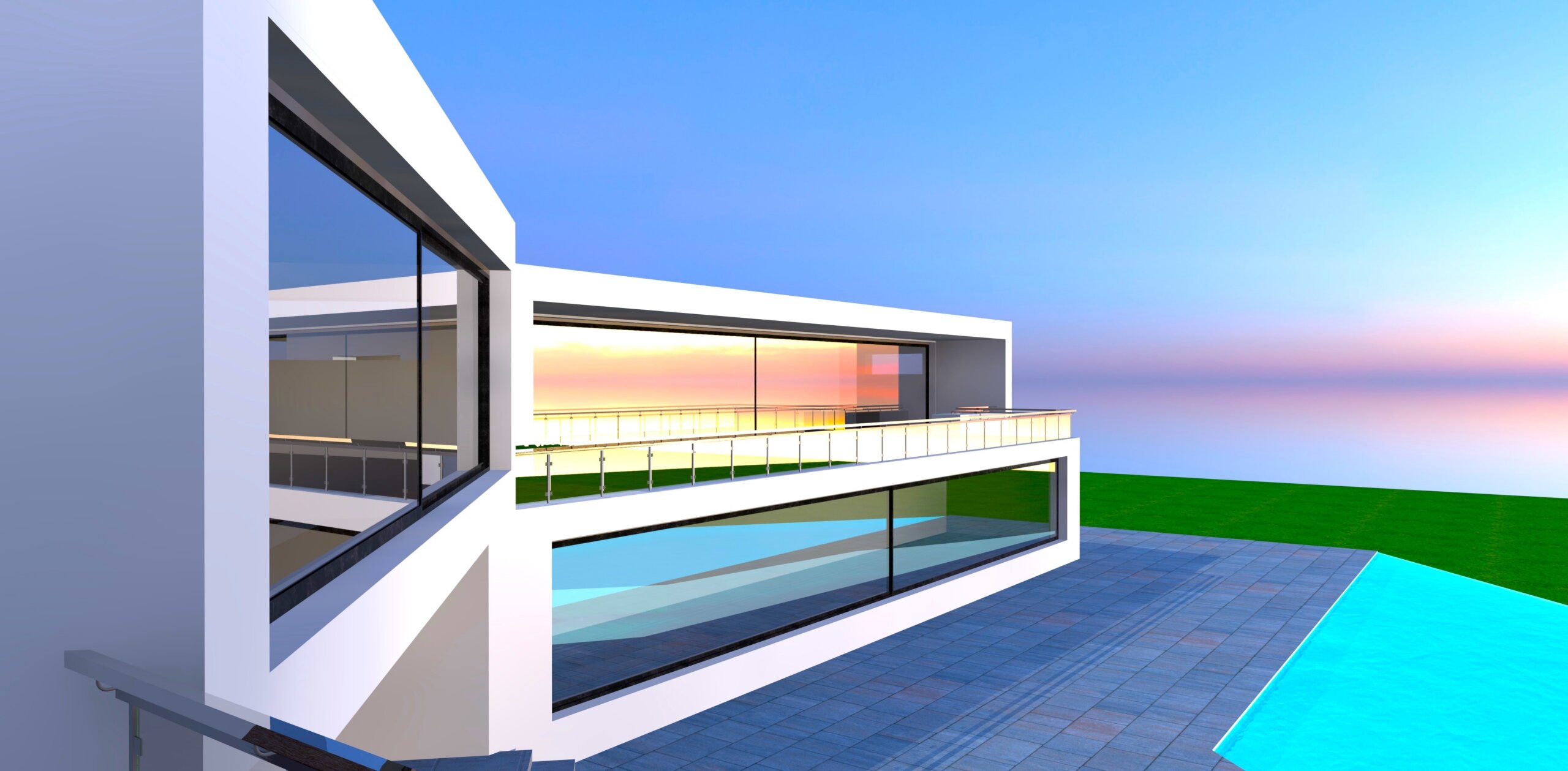
When a project includes open space, walkability, infrastructure, and site-wide sustainability features, 3D rendering for property developers can make the overall vision easier to understand before construction begins. Not to make the project look better than it is, but to make what it is legible to people who can’t read site plans.
What Actually Needs to Be Shown
Building orientation is a good example of something that’s consequential, complex, and completely invisible in most project communication. A sustainable development designed to maximise passive solar gain positions its buildings to avoid mutual shading, with south-facing glazing unobstructed and adequate separation to prevent overlooking. The same number of units, on the same site, arranged differently, loses much of this benefit.
From the planning documents, both arrangements look like buildings on a site. From a realistic view of the site at ground level — showing how winter sun reaches the living spaces, how the spaces between buildings feel, how the orientation creates natural ventilation paths — the difference becomes immediately apparent to anyone evaluating the project.
The same applies to green infrastructure. Rooftop gardens and community food growing spaces appear in sustainability assessments as environmental mitigation measures. What they can be — places where neighbours meet, where children learn about growing food, where residents feel connected to something other than their individual unit — only becomes clear when they’re shown in their spatial context, accessible from the routes people actually use.
The Audience Is Bigger Than the Specialists
Sustainable real estate has broadened its investor base. ESG-focused funds, impact investors, and institutional capital with sustainability mandates are evaluating projects against criteria that go well beyond building energy performance.
They want to understand whether a development will genuinely reduce car dependency for its residents, whether its green spaces will be used or merely maintained, whether its community infrastructure will create the social conditions that make sustainable living a practical daily reality rather than a theoretical aspiration.
A sustainability report addresses these questions in text. It describes what the project intends. A realistic site visualisation that shows how the mobility network connects to local transit, where community facilities sit relative to where people actually move through the site, and how the open space integrates with the built elements shows what the project will actually be. These are different types of information, and both matter for due diligence.
Planning processes have a similar dynamic. Elected councilors and local residents who are part of the decision-making process are rarely trained to read technical documents.
They form their understanding of a development proposal from what they can see and imagine. A project that can show, clearly and convincingly, how its sustainability strategy creates a better place to live is better positioned in that process than one that can only demonstrate it through technical appendices.
Where the Spatial Logic Makes the Most Difference
Multifamily developments are where site-level design decisions accumulate most. A development of two hundred apartments is a community, and whether that community supports sustainable daily life — whether residents have good options beyond driving, whether they have meaningful access to green space and community facilities, whether the energy system is genuinely integrated into how the buildings function — is determined more by site layout and infrastructure than by any individual building specification.
The difference between a sustainable multifamily development and one that has solar panels and calls itself sustainable is mostly visible at the site level. Showing it requires communicating the site as a system: how buildings, paths, green spaces, and shared infrastructure relate to each other and to the surrounding neighbourhood.
Mixed-use developments have an additional communication challenge. The sustainability case for mixing residential, commercial, and community uses depends on those uses actually being accessible to each other — on a resident being able to walk to a café, a small supermarket, or a shared workspace without getting in a car.
Showing how uses relate spatially, how the ground floor activation connects to pedestrian movement through the site, and how the development relates to the existing neighbourhood fabric is essential for making the mixed-use sustainability argument legible.
Before the Ground Is Broken
The time when design decisions are cheapest to change is also the time when showing what a development will be is hardest — because nothing exists yet to photograph. This is precisely when clearer site communication has the most value.
A sustainable development team that can show planning authorities how water management integrates with landscaping. It can also show investors how mobility infrastructure reduces car dependency, and show future residents how green spaces and community facilities are positioned in relation to daily life, is in a fundamentally stronger position than one that can only explain these things in writing.
The explanation is necessary. The visual communication is what makes the explanation believable.
Sustainable communities are complicated to build and complicated to explain. The explanation problem is solvable. Solving it before the design is finalised means that the feedback developers receive from stakeholders is actually about the project — rather than about the version of the project those stakeholders were able to imagine from incomplete information.