


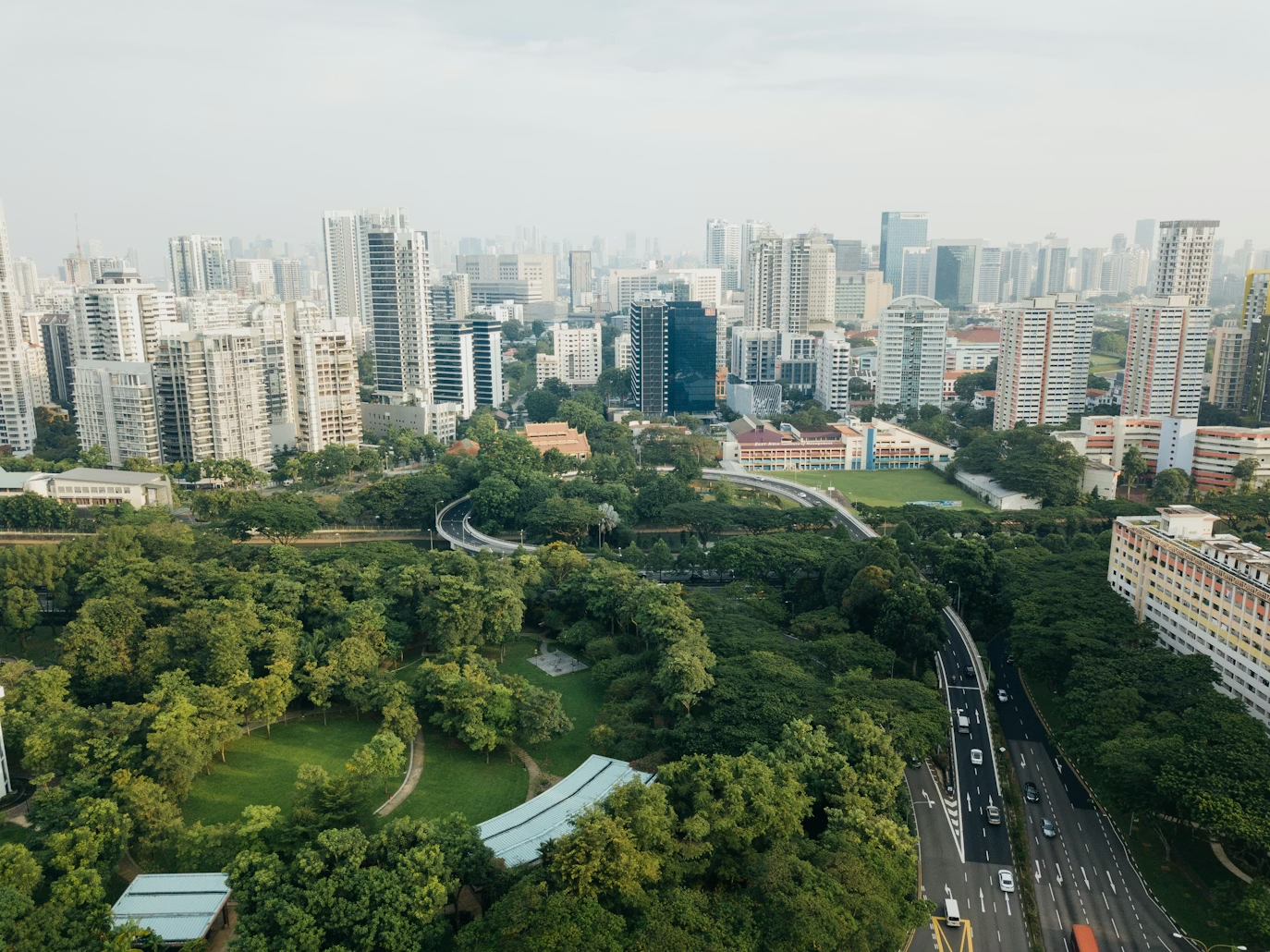
3 Overlooked Urban Elements That Support Sustainable Living
In discussions revolving around sustainability, cities often get a bad name. However, such a reputation is unfair because urban elements tend to get lumped into a narrow description. This often includes ‘too dense, too concrete, and too fast to ever feel truly green.
It is too simplistic a narrative since the reality is more fascinating than it seems. According to the UNEP Emissions Gap Report 2024, urban areas are responsible for around 70% of global CO2 emissions. This holds even though such areas occupy a small fraction of the Earth’s surface.
It may seem counterintuitive, but the report also made it clear that cities are not the only problem. They also have the potential to become central to the solution, acting as key spaces for climate action and innovation. They are equally rife with overlooked elements that support sustainability.
Want to know more? Keep reading as this article will share three such overlooked urban details. We will view cities a little differently, mainly as systems already full of climate-control logic, provided that this is acknowledged.
Exterior Surfaces That Can Double Up as Thermal Regulators
Any building’s exterior surface is viewed as its ‘skin.’ This means it serves as a means of imparting color and identity. Essentially, one can associate the visual layer on the outside with a particular structure. However, what often goes unnoticed is how the exterior surface interacts with sunlight, heat, and other weather conditions.
Depending on their material and finish, exterior surfaces decide how much heat is absorbed during the day. Darker, denser finishes tend to hold onto warmth. On the other hand, lighter, reflective surfaces gently push heat and light away. It can quite literally influence the level of comfort for entire neighborhoods.
Now, the process of maintaining these surfaces also plays a key role in their performance. In other words, exterior painting isn’t merely about giving a tired facade a new look. It is also a carefully-timed interaction with weather itself.
EA Pro Painters notes that exterior painting is usually done between late Spring and early Fall (May through September). That’s when the air is dry, and temperatures above 50° F allow coatings to settle into the surface.
Such a relationship between exterior surfaces and climate matters a lot in places like Bellevue in the US state of Washington. There, buildings are growing denser and taller with rapid urbanization. So, a simple visual change is no longer enough.
It must become a part of how a building learns to handle its own exposure to heat, light, and time. This is where exterior painters in Bellevue step into a larger story. Their work sits at the crossroads of maintenance and material science, which shapes a building’s look and interaction with its changing environment.
On that note, let’s break down the ways in which exterior surfaces support sustainable living:
- They decide how much sunlight a building absorbs or reflects throughout the day.
- They help keep indoor spaces cooler in warm weather.
- They reduce the amount of energy needed for air-conditioning.
- They affect the buildup of heat in crowded city areas.
- They increase the longevity of buildings with better surface protection.
Practical Ways to Utilize This Element
- Choose lighter or reflective exterior colors to reduce heat absorption.
- Schedule repainting or surface maintenance during stable dry seasons for long-lasting results.
- Select durable, climate-appropriate paints that reduce the need for repainting.
- Match coating types to local climatic conditions, be it heat, rain, or humidity.
- Combine surface treatments with shading elements, including overhangs, for better cooling.
Passive Features of Shade That Reduce Energy Demand
The fact that these shade features are passive tends to make them easily overlooked. They are those small, often unnoticed areas of shade created by everyday architectural design. Think about window recesses, balcony projections, and the edges of buildings.
Since these features are built into the structure itself, it makes sense that their impact is easily ignored. By themselves, these shadow areas may seem insignificant. However, together, they can reduce direct sunlight hitting building surfaces and surrounding streets. This brings down heat absorption and helps stabilize outdoor and indoor temperatures throughout the day.
As per 2024 research on urban form and thermal performance, shade created by building geometry can considerably reduce heat stress and improve thermal comfort in compact urban areas. Some findings even suggest that such shading in dense city conditions contributes as much or more to local cooling than vegetation during peak heat hours.
Who would have thought that such an inbuilt climate function could be this powerful, right? Let’s elaborate a bit more on how this overlooked urban element supports sustainable living:
- Direct solar heat gain on buildings and streets is reduced.
- Indoor cooling demands during the warm season fall.
- Outdoor comfort increases without additional energy use.
- No extra systems or active maintenance are required.
Practical Ways to Utilize This Element
- Design buildings to utilize sunlight in a way that shadows naturally emerge.
- Treat naturally created shadows as a part of thermal design, not separate from it.
- Maintain a thoughtful space between buildings.
- Use a combination of reflective materials for maximum energy savings.
The Tiny Crevices Where Nature Blooms
When the term urban sustainability is mentioned, many of us start thinking in grand forms. The association is likely to be made with parks stretching across neighborhoods, tree-lined boulevards, or curated green corridors. In reality, some of the most thriving forms of urban nature are much smaller and hence easy to miss.
They appear in sidewalk cracks where a blade of grass insists on growing with determination against all odds. There are other such areas like narrow seams beside buildings, forgotten fence lines, and quiet corners where soil has gathered without invitation. These are not designed green spaces. They are accidental ones, showing up as tiny crevices where life refuses to silence itself.
Again, when such crevices are combined, they form a scattered but resilient ecological network woven through the city’s harder edges. They are never planned, barely require maintenance, and still thrive season after season.
According to an analysis conducted in 2025 of 55 global studies, urban voids such as leftover patches of land and fragmented spaces can support diverse plant communities. They can function as unexpected habitats for spontaneous vegetation in cities. Despite being widespread, such areas usually remain absent from urban planning discussions.
Cities are already hosting nature in the margins. These spaces support sustainable living in the following ways:
- Serving as a natural habitat for plants to take root and survive
- Adding scattered layers of biodiversity across dense urban landscapes
- Helping the soil absorb and hold water in unexpected places
- Easing surface heat via small but widespread pockets
Practical Ways to Utilize This Element
- Allow spontaneous vegetation to grow rather than sealing every small gap with concrete or asphalt.
- Design urban edges, like walls and fences, with small soil pockets or planting strips.
- Use native, low-maintenance plants in leftover edge spaces to support local biodiversity.
- Treat vacant or fragmented spaces as temporary ecological zones instead of wasted land.
- Encourage city planning to recognize small-scale vegetation as part of urban green infrastructure.
It’s a sad reality that cities have become adept at ignoring their problems until they become too loud to brush aside. The climate change issue, despite being a heated topic for decades, is only getting worse.
Now is the best time to utilize the elements that urban planners have been overlooking. If we pay no attention to the already available, low-cost solutions, what difference would over-the-top, dramatic changes make?
The irony is quite simple: The less we notice the simple urban elements of sustainability, the more we end up paying for them later. Can cities become more sustainable? Absolutely, but the best place to start or turn to is details that have always been there, hidden in plain sight.